
What Documents Do Mortgage Lenders Need: Imagine finding your dream home, getting your offer accepted, and then hearing your lender say, “We still need a few more documents before we can move forward.” That situation is far more common than many first-time home buyers expect. In fact, incomplete paperwork is one of the biggest reasons mortgage approvals take longer than necessary.
If you’ve ever wondered, “What documents do mortgage lenders need?”, you’re asking one of the smartest questions before applying for a home loan. Whether you’re purchasing your first house, refinancing an existing mortgage, or applying for an FHA, VA, USDA, or conventional loan, your lender needs proof that you can repay the loan responsibly.
Mortgage lenders don’t request documents simply to create paperwork. Every document helps verify your identity, income, employment, assets, debts, and overall financial stability. Recent guidance from Fannie Mae confirms that lenders commonly request recent pay stubs, W-2s, tax returns (when applicable), bank statements, photo identification, and documentation for assets or special income sources. Many lenders also use secure digital verification tools to access employment and banking information with the borrower’s consent.
This guide walks through every document you may need in 2026, explains why lenders request each one, and shows you how to prepare your paperwork before applying so you can avoid unnecessary delays.
Why Mortgage Lenders Ask for Documents?
Buying a home is one of the largest financial commitments most Americans will ever make. Before lending hundreds of thousands of dollars, mortgage companies need confidence that the borrower has stable income, manageable debt, and enough financial reserves to complete the purchase successfully.
Think of the mortgage application like assembling a puzzle. A single document—such as a paycheck—shows only one piece of your financial picture. Your bank statements demonstrate available cash. Tax returns provide a longer history of income. Employment records show job stability. Credit reports reveal how you’ve managed previous financial obligations. When lenders combine all of these pieces, they gain a clearer understanding of your ability to repay the loan.
Mortgage underwriting also involves verifying that the information provided on your application matches official records. For example, lenders frequently request authorization to obtain IRS tax transcripts using IRS Form 4506-C, allowing them to confirm reported income directly with the IRS when required. This helps reduce fraud and improves lending accuracy.
Having every document ready before submitting your application can significantly reduce delays, prevent repeated requests from your loan officer, and improve the overall mortgage approval experience.
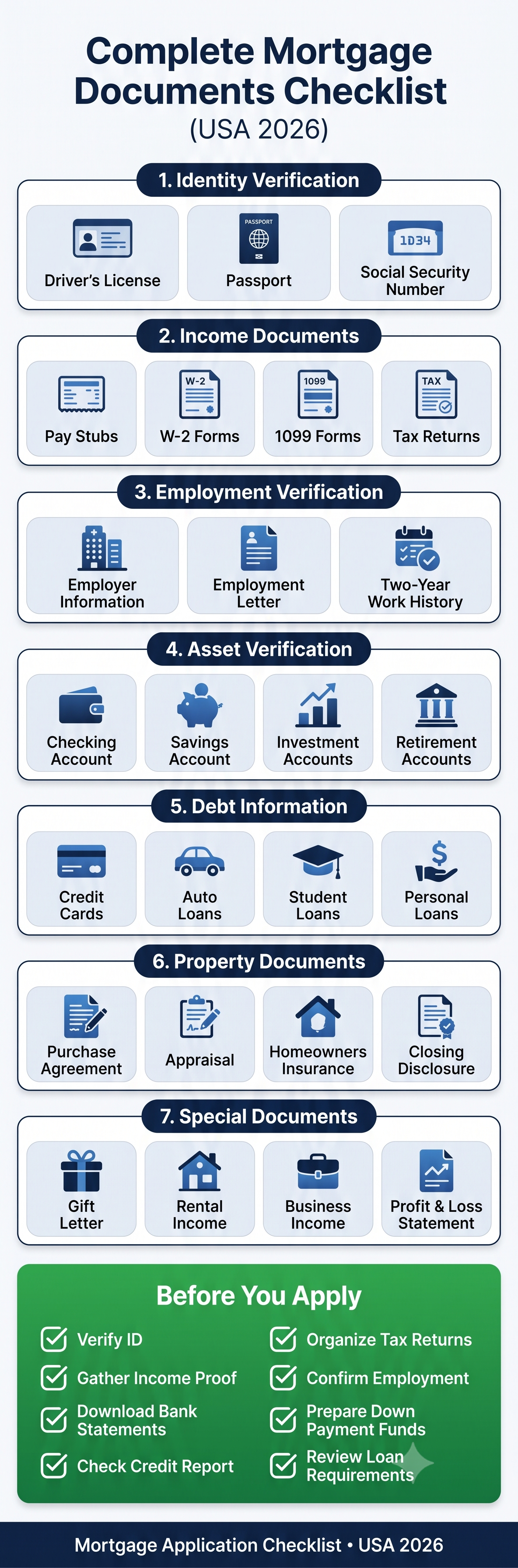
Complete Mortgage Documents Checklist
Below is the complete list of documents most U.S. mortgage lenders commonly request. Keep in mind that requirements vary by lender and loan program, so your loan officer may ask for additional documentation depending on your financial situation.
| Document | Purpose |
|---|---|
| Government-issued Photo ID | Identity verification |
| Social Security Number | Credit and tax verification |
| Recent Pay Stubs | Income verification |
| W-2 Forms | Employment history |
| 1099 Forms | Contractor income |
| Federal Tax Returns | Income confirmation |
| Bank Statements | Asset verification |
| Savings Account Statements | Down payment verification |
| Investment Statements | Reserve funds |
| Retirement Accounts | Financial reserves |
| Gift Letter | Gifted down payment funds |
| Purchase Agreement | Property details |
| Homeowners Insurance | Closing requirement |
| Closing Disclosure | Final loan terms |
Identity & Social Security Verification
Every mortgage application starts with identity verification. Lenders must comply with federal regulations designed to prevent identity theft and financial fraud. Most borrowers provide a valid driver’s license or passport along with their Social Security number. In some situations, lenders may also request proof of legal residency or additional identification documents.
Make sure your identification matches the exact name used on your mortgage application. Even minor discrepancies—such as using a nickname instead of your legal name—can delay processing.
Employment & Income Verification
Stable employment remains one of the strongest indicators that you’ll be able to make future mortgage payments. Most lenders request:
- Pay stubs from the past two months
- W-2 forms from the previous two years
- Employer contact information
- Employment history covering approximately two years
Borrowers earning commissions, bonuses, overtime, or seasonal income may need to provide additional documentation showing that this income has been consistent over time.
If you’re self-employed, expect to submit business tax returns, profit-and-loss statements, and sometimes business licenses in addition to personal tax returns.
Tax Documents
Tax returns give lenders a broader picture of your financial health than pay stubs alone. While your recent income is important, lenders also want to know whether your earnings have been stable over time. That’s why many mortgage programs require copies of your federal tax returns, especially if you’re self-employed, receive commission income, own rental properties, or have multiple income sources.
Most borrowers should be prepared to provide:
- Federal tax returns for the last one or two years (if requested)
- W-2 forms
- 1099 forms (if applicable)
- IRS Form 4506-C authorization
- Tax transcripts, if requested by the lender
A salaried employee with straightforward income may not always need to submit full tax returns if the lender can verify income through alternative methods. However, borrowers with complex finances should expect more detailed documentation.
Pro Tip: Never alter, crop, or redact your tax documents unless your lender specifically instructs you to do so. Missing pages or incomplete returns often trigger additional underwriting reviews.
Bank Statements
Your bank statements help lenders verify that you have enough money available for your down payment, closing costs, reserves, and ongoing financial obligations.
Most lenders request:
- The most recent two months of statements
- Statements for every account used during the transaction
- All pages, even blank pages
- Explanations for unusually large deposits
Large unexplained deposits are one of the most common reasons underwriters ask for additional documentation. For example, if you suddenly deposit $15,000 into your checking account shortly before applying for a mortgage, the lender may ask where that money came from. If it was a gift from a family member, you’ll usually need a signed gift letter and supporting documentation.
Avoid making major financial changes during the mortgage process. Opening new accounts, transferring large sums between accounts, or making large cash deposits can complicate underwriting.
Savings Accounts
Savings accounts demonstrate your ability to build financial reserves. Lenders generally like to see consistent saving habits rather than sudden deposits right before applying.
Savings may be used for:
- Down payment
- Closing costs
- Emergency reserves
- Required cash reserves after closing
Even if your savings account isn’t being used directly for the home purchase, providing statements may strengthen your mortgage application by showing financial stability.
Investment Accounts
Many borrowers forget that investment accounts can strengthen a mortgage application.
These may include:
- Brokerage accounts
- Mutual funds
- Stocks
- Bonds
- Exchange-Traded Funds (ETFs)
Lenders usually don’t require you to liquidate investments. Instead, these accounts demonstrate additional financial strength and can sometimes count toward required reserves depending on the loan program.
Provide complete statements showing:
- Account ownership
- Current balance
- Recent transactions
- Investment value
Retirement Accounts
Retirement savings may also be considered assets.
Examples include:
- 401(k)
- Traditional IRA
- Roth IRA
- Pension accounts
- SEP IRA
- SIMPLE IRA
Although retirement funds aren’t always intended for a home purchase, lenders often include them when evaluating your overall financial profile.
If you’re planning to withdraw retirement funds for your down payment, discuss the tax implications with a financial professional before doing so.
Debt Information
Mortgage lenders don’t only evaluate your income—they also examine your existing financial obligations.
Common debts include:
- Auto loans
- Student loans
- Credit cards
- Personal loans
- Home equity loans
- Child support
- Alimony
These obligations help lenders calculate your Debt-to-Income (DTI) Ratio, one of the most important factors in mortgage approval.
A lower DTI generally improves your chances of qualifying for favorable loan terms.
Credit Report
Instead of asking applicants to submit their own credit reports, lenders typically obtain reports directly from the major credit bureaus after receiving authorization.
Your credit report helps verify:
- Payment history
- Outstanding debts
- Credit utilization
- Account age
- Recent inquiries
- Public records
Even if your credit score is excellent, review your credit reports before applying. Correcting errors in advance may improve your eligibility and potentially lower your interest rate.
Monthly Obligations
Underwriters carefully review your recurring monthly expenses because these affect your ability to manage a mortgage payment.
Examples include:
- Car payments
- Student loans
- Credit card minimum payments
- Personal loans
- Child support
- Alimony
- Existing mortgages
- HOA dues (when applicable)
Accurate reporting helps lenders calculate your borrowing capacity more precisely.
Asset Documentation
Assets demonstrate financial strength beyond regular income.
Common asset documentation includes:
| Asset Type | Example Documents |
|---|---|
| Checking Account | Recent statements |
| Savings Account | Monthly statements |
| Investment Account | Brokerage statements |
| Retirement Account | 401(k) statements |
| Certificates of Deposit | Account statements |
| Cash Value Life Insurance | Policy documentation |
The stronger your documented assets, the more confidence lenders have in your ability to handle unexpected financial situations after closing.
Gift Letters
Many first-time home buyers receive financial assistance from family members for their down payment.
If part of your down payment is gifted, lenders generally require a signed gift letter stating:
- Donor’s name
- Relationship to borrower
- Gift amount
- Confirmation that repayment is not expected
- Donor’s signature
Additional documentation may also be requested to verify the transfer of funds.
Rental Income Documents
If rental income is part of your qualifying income, lenders may ask for:
- Lease agreements
- Tax returns
- Schedule E
- Proof of rental deposits
- Property ownership documentation
Rental income calculations vary depending on occupancy history and lender guidelines.
Business Income Documents
Business owners often face additional documentation requirements because income may fluctuate from year to year.
Typical documents include:
- Business tax returns
- Profit and Loss Statement
- Balance Sheet
- Business bank statements
- Business license
- CPA letter (when requested)
Keeping organized financial records throughout the year can make mortgage approval much smoother.
Property Purchase Agreement
Once your offer has been accepted, you’ll provide a signed purchase agreement.
This document includes:
- Purchase price
- Property address
- Seller information
- Buyer information
- Closing timeline
- Earnest money details
- Contract contingencies
The purchase agreement forms the foundation of the lender’s review of the specific property.
Homeowners Insurance
Before closing, you’ll need proof that the property will be insured.
Your lender typically requests:
- Insurance declaration page
- Coverage details
- Annual premium
- Effective date
Homeowners insurance protects both you and the lender against financial losses from covered events.
Property Appraisal
Nearly every mortgage transaction requires a professional appraisal.
The appraisal confirms:
- Market value
- Property condition
- Comparable sales
- Safety concerns
- Loan-to-value ratio
If the appraisal comes in lower than the purchase price, additional negotiations or changes to financing may be necessary.
Closing Disclosure
The Closing Disclosure is one of the final documents you’ll receive before signing your mortgage.
It summarizes:
- Loan amount
- Interest rate
- Monthly payment
- Closing costs
- Escrow details
- Cash required at closing
Federal rules generally require borrowers to receive this document at least three business days before closing, giving buyers time to review the final loan terms carefully.

Documents Needed for Different Loan Types
Although many mortgage documents are universal, each loan program has unique requirements.
| Loan Type | Additional Documents Often Required |
|---|---|
| FHA Loan | Gift fund documentation, FHA-specific disclosures |
| VA Loan | Certificate of Eligibility (COE), military service records when applicable |
| USDA Loan | Income eligibility documentation, rural property verification |
| Conventional Loan | Standard income and asset verification |
| Jumbo Loan | Additional reserves, higher asset documentation, larger income verification |
FHA Loan Documents
FHA loans are popular with first-time home buyers because they often require lower down payments and offer more flexible credit requirements.
Borrowers typically provide:
- Standard income documentation
- Government-issued identification
- Social Security verification
- Bank statements
- Gift fund documentation (if applicable)
- FHA-required disclosures
VA Loan Documents
VA loans are available to eligible veterans, active-duty service members, and certain surviving spouses.
Additional documentation usually includes:
- Certificate of Eligibility (COE)
- Military service documentation
- DD Form 214 (for many veterans)
- Standard income verification
- Asset documentation
USDA Loan Documents
USDA loans support eligible buyers purchasing homes in qualifying rural areas.
Additional documentation may include:
- Household income verification
- Property eligibility confirmation
- USDA-specific disclosures
Conventional Loan Documents
Conventional mortgages generally rely on:
- Employment verification
- Income verification
- Asset documentation
- Credit evaluation
- Down payment verification
Borrowers with stronger credit profiles often enjoy more flexibility under conventional lending guidelines.
Jumbo Loan Documents
Jumbo loans exceed conforming loan limits and therefore involve more detailed financial reviews.
Expect lenders to request:
- Larger cash reserve documentation
- Additional investment statements
- More comprehensive income verification
- Detailed asset documentation
- Enhanced underwriting review
High-value mortgages involve greater financial risk for lenders, making documentation requirements more extensive.
Extra Documents Self-Employed Borrowers Need
Being self-employed doesn’t mean getting a mortgage is harder—it simply means you’ll need to provide more evidence that your income is stable and likely to continue. Unlike salaried employees who receive predictable paychecks, business owners, freelancers, consultants, independent contractors, and gig workers often have fluctuating income. Because of this, mortgage lenders perform a more detailed review of your finances.
If you’re self-employed, expect to provide many of the standard mortgage documents along with additional business-related records.
Typical Documents Required for Self-Employed Borrowers
| Document | Why It’s Needed |
|---|---|
| Personal tax returns (last 2 years) | Verify personal income history |
| Business tax returns | Confirm business earnings |
| Profit & Loss Statement | Show current business performance |
| Business bank statements | Verify cash flow |
| Balance Sheet | Review the business’s financial health |
| Business license (if applicable) | Confirm active business |
| CPA letter (sometimes requested) | Verify business status |
| 1099 income statements | Confirm contract income |
| Schedule C, K-1, or partnership documents | Verify business ownership and earnings |
Lenders may also compare your year-to-date income with previous tax returns. If your income has significantly decreased, your loan officer may ask for an explanation or updated financial statements.
Pro Tip
Keep your personal and business finances separate. Using dedicated business bank accounts makes mortgage underwriting much easier because lenders can clearly identify business income and expenses.
Common Mortgage Document Mistakes
Many mortgage applications are delayed not because borrowers don’t qualify, but because paperwork is incomplete or inconsistent. Even small mistakes can trigger additional reviews from underwriting, adding days—or even weeks—to the approval process.
Some of the most common mistakes include:
- Missing pages from bank statements
- Expired identification
- Illegible scanned documents
- Large unexplained deposits
- Incorrect employment dates
- Using estimated income instead of documented income
- Forgetting to include all W-2s or 1099s
- Opening new credit accounts during underwriting
- Making large purchases before closing
- Providing outdated financial statements
Real-Life Example
Imagine Sarah is buying her first home. She submits two months of bank statements, but one page is blank, so she leaves it out. The underwriter requests the missing page because every page must be included, even if it’s blank. That small oversight delays her closing by several days.
The lesson is simple: provide complete documents exactly as requested.
How to Organize Your Mortgage Paperwork?
Preparing your documents before you apply can make the mortgage process much smoother. Instead of scrambling to locate paperwork every time your loan officer asks for something, create a dedicated mortgage folder.
Recommended Folder Structure
Identity
- Driver’s License
- Passport
- Social Security documentation
Income
- Pay stubs
- W-2 forms
- 1099 forms
- Tax returns
Employment
- Employer information
- Employment verification letters
Assets
- Checking account statements
- Savings account statements
- Investment account statements
- Retirement account statements
Property
- Purchase agreement
- Earnest money receipt
- Homeowners insurance
- Appraisal documents
Business (Self-Employed)
- Profit & Loss Statement
- Business tax returns
- Business bank statements
- CPA documentation
Keeping digital copies in clearly labeled folders makes it easier to upload documents through your lender’s secure portal. Avoid sending blurry photos taken with your phone unless the lender specifically allows it. High-quality PDF files are usually the preferred format.
How Long Do Mortgage Documents Stay Valid?
One question borrowers frequently ask is whether they can gather documents months before applying. The answer depends on the type of document.
| Document | Typical Validity |
|---|---|
| Pay Stubs | 30–60 days |
| Bank Statements | Most recent 2 months |
| Driver’s License | Must be valid at closing |
| Credit Report | Varies by lender; may require a refresh before closing |
| Employment Verification | Usually updated shortly before closing |
| Homeowners Insurance | Active on closing day |
| Appraisal | Typically valid for several months, subject to lender guidelines |
If your home search takes longer than expected, be prepared to provide updated versions of certain documents before closing. This is completely normal and helps ensure your financial situation hasn’t changed significantly since you first applied.
Practical Mortgage Document Checklist
Before submitting your mortgage application, confirm you have the following:
- ✅ Government-issued photo ID
- ✅ Social Security Number
- ✅ Recent pay stubs
- ✅ W-2 forms
- ✅ 1099 forms (if applicable)
- ✅ Federal tax returns (if requested)
- ✅ Two months of bank statements
- ✅ Savings account statements
- ✅ Investment account statements
- ✅ Retirement account statements
- ✅ Debt information
- ✅ Purchase agreement
- ✅ Gift letter (if applicable)
- ✅ Homeowners insurance information
- ✅ Rental income documentation (if applicable)
- ✅ Business financial documents (if self-employed)
Having these documents ready before you begin the application process can reduce delays and help your lender move your file through underwriting more efficiently.
Conclusion
Applying for a mortgage may seem overwhelming at first, but understanding the documentation process removes much of the uncertainty. Every document your lender requests serves a specific purpose, whether it’s confirming your identity, verifying your income, evaluating your assets, or ensuring the property meets lending requirements.
While the exact requirements vary depending on the lender, loan program, and your financial situation, most borrowers will need identification, proof of income, employment records, bank statements, and property-related documents. Self-employed applicants, investors, and borrowers with multiple income sources should expect to provide additional documentation.
The best way to avoid unnecessary delays is to prepare early. Create a digital folder, organize your financial records, review your credit, and respond promptly to any requests from your loan officer. A well-prepared application not only saves time but also demonstrates financial responsibility throughout the mortgage process.
Finally, remember that mortgage guidelines can change over time, and individual lenders may have unique requirements. Always confirm the exact document checklist with your lender before submitting your application to ensure nothing is overlooked.
Frequently Asked Questions (FAQs)
1. What documents do mortgage lenders need for approval?
Most lenders require a government-issued photo ID, Social Security verification, recent pay stubs, W-2s, bank statements, employment information, and documentation of assets and debts. Additional paperwork may be required depending on your loan type and financial situation.
2. How many bank statements do mortgage lenders require?
Most lenders ask for the most recent two months of statements for all accounts used in the transaction. Some situations may require additional statements.
3. How many pay stubs are needed for mortgage approval?
Typically, lenders request your most recent 30 to 60 days of pay stubs, although requirements can vary.
4. Do all borrowers need to submit tax returns?
Not always. Salaried employees with straightforward income may not need full tax returns, while self-employed borrowers and those with complex income often do.
5. What if I receive gift money for my down payment?
You’ll generally need a signed gift letter and documentation showing the transfer of funds, depending on the loan program and lender requirements.
6. Can I use digital bank statements?
Yes. Most lenders accept electronic statements downloaded directly from your financial institution, provided they include all pages and account details.
7. What documents do self-employed borrowers need?
Self-employed applicants typically provide personal and business tax returns, profit and loss statements, business bank statements, and other records that verify business income.
8. Will lenders verify my employment before closing?
Yes. Many lenders perform a final employment verification shortly before closing to confirm that you’re still employed.
9. Can opening a new credit card affect mortgage approval?
It can. Opening new credit accounts or taking on additional debt during underwriting may affect your credit score and debt-to-income ratio, potentially impacting your loan approval.
10. Should I ask my lender for a personalized checklist?
Absolutely. Every lender has its own underwriting guidelines. Requesting a customized checklist at the beginning of the process helps ensure you provide exactly what’s needed.
