
Learn how a mortgage calculator works with real examples, payment formulas, taxes, PMI, HOA, and budgeting tips for U.S. home buyers in 2026.
Buying a home is exciting, but one question quickly becomes the center of attention:
Mortgage Calculator“How much will my monthly mortgage payment actually be?”
That sounds simple until you realize a mortgage payment is much more than just the loan amount. Property taxes, homeowners insurance, PMI, HOA fees, interest rates, loan terms, and your down payment all affect what you’ll pay every month.
That’s exactly where a mortgage calculator becomes one of the most valuable financial tools you’ll ever use.
Whether you’re purchasing your first home, refinancing your current mortgage, or comparing loan offers, a reliable mortgage payment calculator helps you estimate costs before you ever submit an application. While online calculators provide an excellent estimate, lenders calculate payments using the same standard amortization formula but also include your actual taxes, insurance, escrow setup, and loan-specific details.
This guide explains everything in plain English, complete with real-world examples that make mortgage calculations easy to understand.
Why Every Home Buyer Should Use a Mortgage Calculator
A mortgage isn’t just another monthly bill—it’s usually the largest financial commitment most Americans ever make.
Without running the numbers first, it’s surprisingly easy to fall in love with a house that stretches your budget too far.
A mortgage affordability calculator helps you estimate:
- Your expected monthly payment
- Total interest over the loan
- Estimated taxes and insurance
- PMI costs
- How different down payments affect affordability
- Whether a 15-year or 30-year loan makes more sense
Instead of guessing what you can afford, you’re making decisions based on realistic numbers.
What Is a Mortgage Calculator?
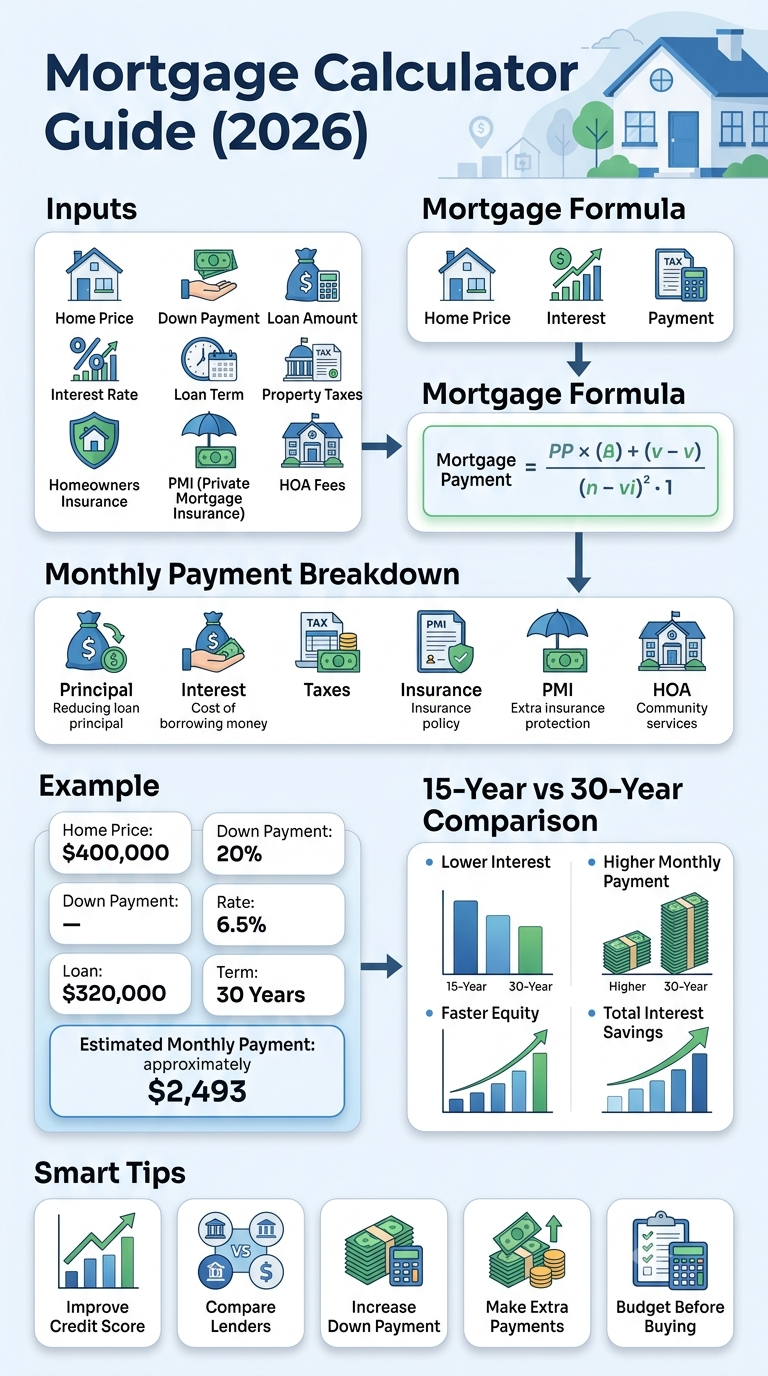
A mortgage calculator is an online financial tool that estimates your monthly home loan payment using information such as:
| Input | Description |
|---|---|
| Home Price | Purchase price |
| Down Payment | Cash paid upfront |
| Loan Amount | Amount borrowed |
| Interest Rate | Annual loan rate |
| Loan Term | Usually 15 or 30 years |
| Property Taxes | Annual estimate |
| Homeowners Insurance | Annual premium |
| PMI | If required |
| HOA Fees | Monthly dues if applicable |
Most modern calculators also estimate:
- Total loan cost
- Total interest
- Amortization schedule
- Remaining balance
- Extra payment savings
How Mortgage Calculators Work?
Mortgage calculators rely on the same standard amortization formula lenders use for fixed-rate loans to estimate the principal and interest portion of your payment. Your actual monthly payment is usually higher because taxes, insurance, and sometimes mortgage insurance are added through escrow.
The basic formula is:
M = P × [r(1+r)^n] ÷ [(1+r)^n − 1]
Where:
- M = Monthly payment
- P = Loan amount
- r = Monthly interest rate
- n = Number of monthly payments
Don’t worry—you rarely need to calculate this manually because calculators handle the math instantly.
What Is PITI?
You’ll often hear lenders use the term PITI, which stands for:
| Component | Meaning |
|---|---|
| P | Principal |
| I | Interest |
| T | Property Taxes |
| I | Homeowners Insurance |
Some borrowers also pay:
- PMI
- HOA fees
- Flood insurance
Ignoring these expenses can make your monthly budget look much lower than reality, which is why comprehensive mortgage calculators include them whenever possible.
Mortgage Payment Components
Here’s what typically makes up your monthly payment:
| Component | Purpose |
|---|---|
| Principal | Pays down your loan balance |
| Interest | Cost of borrowing |
| Property Taxes | Local government taxes |
| Homeowners Insurance | Protects your home |
| PMI | Required for many low-down-payment conventional loans |
| HOA Fees | Community association dues |
During the early years of a mortgage, a larger share of your payment goes toward interest. As your balance declines, more of each payment goes toward reducing principal and building equity.
Mortgage Calculator Inputs Explained
Before a mortgage calculator can estimate your monthly payment, it needs a few key pieces of information. Every number you enter affects the final estimate, so understanding each input helps you make smarter decisions. While many first-time buyers focus only on the home price, lenders—and accurate calculators—look at the complete financial picture.
Home Purchase Price
The purchase price is the amount you’ve agreed to pay for the property. This serves as the starting point for every mortgage calculation. A higher purchase price generally means a larger loan unless you make a substantial down payment.
Example:
| Home Price | Down Payment | Loan Amount |
|---|---|---|
| $300,000 | $60,000 (20%) | $240,000 |
| $450,000 | $90,000 (20%) | $360,000 |
| $600,000 | $120,000 (20%) | $480,000 |
Even a small increase in home price can raise your monthly payment significantly over the life of a loan.
Down Payment
Your down payment is the amount you pay upfront rather than financing. A larger down payment reduces the amount you borrow, lowers monthly payments, and may eliminate the need for Private Mortgage Insurance (PMI) on many conventional loans.
Typical down payment ranges include:
- 3%–5%: Common for first-time buyers
- 10%: Lowers the loan amount and interest costs
- 20%: Often avoids PMI on conventional loans
- More than 20%: Provides even greater long-term savings
The right down payment depends on your finances, savings goals, and loan program.
Interest Rate
Your interest rate is one of the biggest factors affecting your monthly payment. Even a difference of 0.5% can change your payment by hundreds of dollars each month on larger loans.
Factors that influence your interest rate include:
- Credit score
- Debt-to-income ratio (DTI)
- Down payment size
- Loan type
- Current market conditions
- Loan term
Because rates fluctuate frequently, it’s wise to compare multiple lenders before locking your rate.
Loan Term
The loan term is the amount of time you’ll repay your mortgage.
The most common options are:
- 15 years
- 20 years
- 30 years
A shorter loan term usually means:
- Higher monthly payments
- Lower total interest
- Faster equity growth
A longer term generally provides:
- Lower monthly payments
- Higher total interest
- Greater monthly cash-flow flexibility
Choosing the right term depends on your financial goals rather than simply picking the lowest monthly payment.
Property Taxes
Property taxes vary by state, county, and city. Many mortgage calculators allow you to enter either:
- Annual property tax
- Property tax percentage
Lenders usually collect these taxes through an escrow account, dividing the annual amount into monthly payments.
Homeowners Insurance
Homeowners insurance protects your property from covered risks such as fire, storms, theft, and certain types of damage. Mortgage lenders typically require insurance before approving a loan.
Most calculators estimate this as an annual cost that is divided into monthly escrow payments.
PMI (Private Mortgage Insurance)
If you’re putting less than 20% down on a conventional mortgage, you’ll likely pay PMI.
PMI protects the lender—not the borrower—in case of default.
The cost depends on:
- Loan amount
- Credit score
- Down payment
- Loan type
Many mortgage calculators let you include PMI for a more realistic monthly estimate.
HOA Fees
If you’re buying a condo, townhouse, or home in a planned community, you’ll often pay Homeowners Association (HOA) fees.
HOA fees may cover:
- Landscaping
- Community pools
- Security
- Clubhouses
- Road maintenance
- Shared amenities
Although HOA fees aren’t part of the mortgage itself, they should always be included when calculating your total monthly housing expense.
Mortgage Calculator Outputs Explained
Once you’ve entered your information, the calculator generates several useful estimates that help you understand the true cost of your mortgage.
Typical Outputs
| Output | What It Shows |
|---|---|
| Monthly Principal & Interest | Core loan payment |
| Taxes | Estimated monthly property taxes |
| Insurance | Homeowners insurance |
| PMI | Monthly mortgage insurance if applicable |
| HOA Fees | Community fees |
| Total Monthly Payment | Combined housing cost |
| Total Interest Paid | Interest over the loan life |
| Total Loan Cost | Principal + Interest |
| Amortization Schedule | Payment breakdown over time |
These outputs give you a realistic estimate of what homeownership may cost each month.
Mortgage Calculation Example #1 — 30-Year Fixed Mortgage
Let’s walk through a practical example.
Loan Details
| Item | Value |
|---|---|
| Home Price | $400,000 |
| Down Payment | 20% ($80,000) |
| Loan Amount | $320,000 |
| Interest Rate | 6.50% |
| Loan Term | 30 Years |
Step 1 — Calculate the Loan Amount
$400,000 − $80,000 = $320,000This is the amount being financed.
Step 2 — Estimate Monthly Principal & Interest
Using a standard mortgage calculator:
Estimated Principal & Interest: ≈ $2,023/month
Step 3 — Add Taxes and Insurance
Assume:
- Property Taxes = $350/month
- Homeowners Insurance = $120/month
- HOA = $0
- PMI = None (20% Down)
| Payment Component | Monthly Cost |
|---|---|
| Principal & Interest | $2,023 |
| Property Taxes | $350 |
| Insurance | $120 |
| PMI | $0 |
| HOA | $0 |
| Estimated Total Payment | $2,493/month |
This estimate gives a much clearer picture than looking only at the loan payment.
Mortgage Calculation Example #2 — 15-Year Fixed Mortgage
Now let’s compare a shorter loan term using the same home price.
Loan Details
| Item | Value |
|---|---|
| Home Price | $400,000 |
| Down Payment | 20% |
| Loan Amount | $320,000 |
| Interest Rate | 6.00% |
| Loan Term | 15 Years |
Estimated Payment
| Component | Amount |
|---|---|
| Principal & Interest | $2,700 |
| Property Taxes | $350 |
| Insurance | $120 |
| Total Payment | $3,170/month |
Although the monthly payment is significantly higher, you’ll repay the loan in half the time and typically save tens of thousands of dollars in total interest compared with a 30-year mortgage.
Comparing 15-Year vs. 30-Year Mortgage
| Feature | 15-Year Loan | 30-Year Loan |
|---|---|---|
| Monthly Payment | Higher | Lower |
| Interest Rate | Often Slightly Lower | Usually Slightly Higher |
| Total Interest Paid | Much Less | Much More |
| Equity Builds | Faster | Slower |
| Loan Paid Off | 15 Years | 30 Years |
| Best For | Higher Income Borrowers | Buyers Seeking Lower Payments |
A 15-year loan can be an excellent option if your budget comfortably supports the larger payment. If cash flow is a priority, a 30-year mortgage offers more flexibility while still allowing you to make extra principal payments when possible.
Example: How Interest Rates Change Monthly Payments
Even a small increase in the interest rate can noticeably affect your payment.
Loan Amount: $350,000
Loan Term: 30 Years
| Interest Rate | Estimated Monthly Principal & Interest |
|---|---|
| 5.50% | ~$1,987 |
| 6.00% | ~$2,099 |
| 6.50% | ~$2,212 |
| 7.00% | ~$2,329 |
| 7.50% | ~$2,447 |
This example shows why comparing mortgage offers from multiple lenders can have a meaningful impact on your long-term borrowing costs.
Key Takeaways from These Examples
These examples illustrate that your monthly payment depends on far more than the home’s purchase price. Your down payment, interest rate, loan term, taxes, insurance, and other housing costs all work together to determine what you’ll actually pay each month. Using a comprehensive mortgage calculator before making an offer can help you set realistic expectations, compare financing options, and choose a home that fits comfortably within your budget.
Mortgage Calculation Example #3 — FHA Loan
An FHA loan is one of the most popular mortgage options for first-time home buyers because it allows a lower down payment and more flexible credit requirements. The trade-off is that most FHA borrowers must pay both an upfront mortgage insurance premium (UFMIP) and an annual mortgage insurance premium (MIP), which increases the monthly payment.
Let’s look at a realistic example.
Loan Details
| Item | Value |
|---|---|
| Home Price | $350,000 |
| Down Payment | 3.5% ($12,250) |
| Loan Amount | $337,750 |
| Interest Rate | 6.25% |
| Loan Term | 30 Years |
Estimated Monthly Costs
| Payment Component | Monthly Cost |
|---|---|
| Principal & Interest | $2,079 |
| Property Taxes | $300 |
| Homeowners Insurance | $110 |
| FHA Mortgage Insurance (MIP) | $180 |
| HOA Fees | $0 |
| Estimated Total Monthly Payment | $2,669 |
This example shows why it’s important to use a mortgage calculator with taxes, insurance, and PMI/MIP instead of one that only calculates principal and interest. Ignoring these additional costs could leave you with a monthly payment that is several hundred dollars lower than reality.
Who Should Consider an FHA Loan?
An FHA loan may be a good fit if you:
- Are buying your first home
- Have limited savings for a down payment
- Have a moderate credit score
- Need more flexible qualification requirements
Although FHA loans make homeownership more accessible, it’s still worth comparing them with conventional loan options before making a final decision.
Mortgage Calculation Example #4 — VA Loan
A VA loan is available to eligible veterans, active-duty service members, and certain surviving spouses. One of its biggest advantages is that qualified borrowers may purchase a home with no down payment and no monthly PMI, making it one of the most affordable financing options available.
Loan Details
| Item | Value |
|---|---|
| Home Price | $425,000 |
| Down Payment | $0 |
| Loan Amount | $425,000 |
| Interest Rate | 6.00% |
| Loan Term | 30 Years |
Estimated Monthly Costs
| Payment Component | Monthly Cost |
|---|---|
| Principal & Interest | $2,548 |
| Property Taxes | $375 |
| Homeowners Insurance | $130 |
| Monthly PMI | $0 |
| HOA Fees | $75 |
| Estimated Total Monthly Payment | $3,128 |
Even though there is no monthly PMI, borrowers should remember that some VA loans include a VA funding fee, unless the borrower qualifies for an exemption. This fee is typically financed into the loan rather than paid monthly.
Benefits of VA Loans
- No minimum down payment for eligible borrowers
- No monthly PMI
- Competitive interest rates
- Flexible qualification standards
- Lower closing costs in many situations
For eligible military families, a VA loan can significantly reduce the cost of homeownership.
Mortgage Calculation Example #5 — Refinancing with Extra Payments
Many homeowners refinance to lower their interest rate, reduce monthly payments, or shorten the loan term. A mortgage calculator for refinance helps estimate whether refinancing will actually save money.
Original Mortgage
| Item | Value |
|---|---|
| Remaining Balance | $275,000 |
| Current Interest Rate | 7.25% |
| Remaining Term | 25 Years |
Monthly Principal & Interest:
≈ $1,989
New Refinance Loan
| Item | Value |
|---|---|
| Loan Balance | $275,000 |
| New Interest Rate | 5.75% |
| New Term | 20 Years |
Estimated Monthly Payment:
≈ $1,926
Although the monthly payment decreases only slightly, the homeowner may save tens of thousands of dollars in interest over the life of the refinanced loan because of the lower rate and shorter repayment period.

Adding Extra Monthly Payments
Now let’s assume the homeowner decides to pay an additional $200 each month toward the loan principal.
Potential Benefits
| Without Extra Payments | With $200 Extra Monthly |
|---|---|
| Loan Paid in 20 Years | Loan Paid Several Years Earlier |
| Higher Total Interest | Lower Total Interest |
| Slower Equity Growth | Faster Equity Growth |
Even modest extra payments can dramatically reduce the amount of interest paid over the life of a mortgage because every extra dollar goes directly toward the principal balance.
Understanding Mortgage Amortization
One of the most valuable features of a mortgage amortization calculator is the amortization schedule. This schedule shows exactly how each monthly payment is divided between principal and interest throughout the life of the loan.
During the early years, a larger portion of each payment goes toward interest because the outstanding loan balance is higher. As the balance decreases, less interest accrues each month, allowing more of your payment to reduce the principal. This gradual shift is why homeowners build equity more slowly at first and much faster later in the loan.
Sample Amortization Schedule
| Payment Number | Principal | Interest | Remaining Balance |
|---|---|---|---|
| 1 | $430 | $1,593 | $319,570 |
| 12 | $455 | $1,568 | $314,250 |
| 60 | $575 | $1,448 | $286,900 |
| 120 | $730 | $1,293 | $248,100 |
| 240 | $1,155 | $868 | $129,700 |
| Final Payment | Remaining Principal | Small Interest | $0 |
Seeing this schedule helps borrowers understand how extra payments can shorten the loan and reduce interest costs.
PMI Comparison
Private Mortgage Insurance (PMI) is typically required on many conventional loans when the down payment is less than 20%.
| Down Payment | Typical PMI Requirement |
|---|---|
| 3% | Yes |
| 5% | Yes |
| 10% | Usually Yes |
| 15% | Usually Yes |
| 20% or More | Typically No |
Removing PMI can substantially lower your monthly housing costs, which is one reason many buyers aim for a 20% down payment if possible.
Down Payment Comparison
Let’s see how different down payments affect the loan amount on a $400,000 home.
| Down Payment | Loan Amount |
|---|---|
| 3% | $388,000 |
| 5% | $380,000 |
| 10% | $360,000 |
| 15% | $340,000 |
| 20% | $320,000 |
A larger down payment generally means:
- Lower monthly payments
- Less interest paid over time
- Better loan terms
- Lower risk for the lender
- Potentially no PMI
However, buyers should also maintain an emergency savings fund rather than using every available dollar for the down payment.
Common Mortgage Calculator Mistakes
A mortgage calculator is an excellent planning tool, but it’s only as accurate as the information entered. One of the most common mistakes is leaving out important housing expenses. Many buyers calculate only the loan payment and forget about taxes, insurance, HOA fees, maintenance costs, or PMI. As a result, the estimated payment can be far lower than what they’ll actually owe each month.
Another frequent mistake is assuming today’s interest rate will still be available when they’re ready to buy. Mortgage rates change regularly based on market conditions, inflation, and broader economic trends. Running calculations with several different interest rates can provide a more realistic view of possible monthly payments.
Finally, some buyers overlook closing costs and moving expenses. While these costs aren’t part of the monthly mortgage payment, they still affect how much cash you’ll need when purchasing a home. A complete financial plan should account for both upfront and ongoing housing expenses.
Budgeting Tips Before Buying a Home
Owning a home involves much more than making a mortgage payment each month. Creating a realistic budget before buying can help prevent financial stress later.
Consider setting aside money each month for:
- Routine maintenance and repairs
- Utilities
- Property taxes
- Homeowners insurance
- Emergency savings
- HOA dues (if applicable)
- Landscaping and seasonal maintenance
- Furniture and appliances
A good rule of thumb is to ensure that your monthly housing costs fit comfortably within your overall budget rather than stretching to the maximum amount a lender is willing to approve.
Expert Financial Tips
Financial professionals often recommend these practical strategies before committing to a mortgage:
- Improve your credit score before applying for a loan.
- Compare offers from multiple lenders instead of accepting the first quote.
- Increase your down payment if it doesn’t compromise your emergency savings.
- Consider making occasional extra principal payments to reduce long-term interest costs.
- Review your monthly budget carefully to ensure you can comfortably handle homeownership expenses beyond the mortgage payment itself.
A mortgage calculator is an excellent starting point, but discussing your situation with a qualified mortgage professional can help you understand loan options, closing costs, and payment estimates specific to your financial circumstances.
How Changing Interest Rates Affects Your Monthly Mortgage Payment?
One of the biggest advantages of using a mortgage calculator is that it allows you to instantly see how different interest rates affect your monthly payment. Many home buyers focus only on finding the right home, but even a small change in interest rates can significantly increase—or decrease—the total amount paid over the life of the loan.
For example, imagine you’re financing a $400,000 home with a 20% down payment, leaving a $320,000 loan balance. If you receive a lower interest rate, your monthly payment may fit comfortably within your budget. However, if rates increase before you lock your loan, your payment could rise by hundreds of dollars every month.
The table below illustrates how changing rates can impact the estimated monthly principal and interest payment for the same loan amount over a 30-year term.
| Interest Rate | Estimated Monthly Payment | Estimated Total Interest |
|---|---|---|
| 5.00% | ~$1,718 | Much Lower |
| 5.50% | ~$1,817 | Lower |
| 6.00% | ~$1,919 | Moderate |
| 6.50% | ~$2,023 | Higher |
| 7.00% | ~$2,129 | Significantly Higher |
| 7.50% | ~$2,238 | Very High |
Although the monthly differences may seem manageable at first glance, they compound over hundreds of monthly payments. That’s why many buyers monitor interest rates closely and consider locking their rate once they’re under contract.
Why a Lower Interest Rate Matters?
A lower interest rate provides benefits far beyond a smaller monthly payment. It can improve your overall financial flexibility and reduce the total cost of borrowing.
Some of the biggest advantages include:
- Lower monthly mortgage payments
- Reduced lifetime interest costs
- Faster equity growth
- Easier budgeting
- Greater purchasing power
Even reducing your rate by 0.50% could save tens of thousands of dollars over the life of a typical 30-year mortgage. While every situation is different, comparing multiple loan offers before committing is one of the smartest financial decisions a borrower can make.
Mortgage Calculator vs. Lender Estimate
Many first-time buyers wonder whether they should trust an online mortgage payment calculator or wait for an official estimate from a lender. The truth is that both serve different purposes.
A mortgage calculator is designed to provide a quick estimate based on the information you enter. It helps you compare loan scenarios, experiment with different down payments, and understand how changes in interest rates affect affordability. However, it cannot account for every detail of your unique financial situation.
A lender, on the other hand, calculates your payment using verified financial information, current loan pricing, and property-specific expenses.
Here’s a comparison.
| Mortgage Calculator | Official Lender Estimate |
|---|---|
| Uses estimated values | Uses verified financial information |
| Great for planning | Used for loan approval |
| Provides instant estimates | Includes official loan disclosures |
| Allows scenario comparisons | Based on actual underwriting |
| Doesn’t verify taxes | Uses property-specific taxes |
| May estimate insurance | Uses actual insurance quotes |
| Doesn’t verify credit | Uses your real credit profile |
| Excellent budgeting tool | Final loan payment estimate |
Think of an online calculator as your planning tool and a lender’s estimate as the official financial roadmap for your mortgage.
Why Your Lender’s Payment May Be Different?
Many borrowers are surprised when the lender’s estimated payment doesn’t exactly match what an online calculator showed. That difference doesn’t necessarily mean the calculator was wrong.
Several factors can cause variations, including:
- Updated interest rates
- Actual property taxes
- Final homeowners insurance premium
- Escrow requirements
- Discount points
- Closing cost financing
- HOA dues
- Mortgage insurance premiums
- Loan-specific fees
As your loan progresses through underwriting, these figures become more precise, resulting in a more accurate monthly payment estimate.
Limitations of Mortgage Calculators
Although modern mortgage calculators are incredibly useful, they do have limitations. Understanding these limitations helps you use them more effectively.
1. They Use Estimated Numbers
Unless you know the exact property taxes, insurance premiums, and HOA fees, the calculator must rely on estimates. These estimates may differ from the actual costs associated with a specific property.
2. They Don’t Predict Future Interest Rates
A calculator can only use the interest rate you enter. It cannot forecast where mortgage rates will be next week or next month. If rates change before your loan closes, your payment may also change.
3. They Don’t Guarantee Loan Approval
Just because a calculator says you can afford a particular payment doesn’t mean you’ll qualify for that loan. Lenders evaluate many additional factors, such as:
- Credit history
- Employment stability
- Income verification
- Assets
- Debt-to-income ratio
- Cash reserves
Loan approval depends on your complete financial profile, not just the estimated monthly payment.
4. They Don’t Include Every Homeownership Cost
A mortgage payment is only one part of owning a home. Other expenses may include:
- Maintenance
- Repairs
- Utilities
- Landscaping
- Appliance replacement
- Pest control
- Renovations
Smart buyers budget for these ongoing costs alongside their mortgage payment.
How Much House Can I Afford?
One of the most popular features of a mortgage affordability calculator is determining how much home fits comfortably within your budget. Instead of shopping based solely on the maximum loan amount a lender may approve, it’s often wiser to choose a home that aligns with your long-term financial goals.
When estimating affordability, consider factors such as:
- Household income
- Monthly debt obligations
- Down payment savings
- Emergency fund
- Property taxes
- Insurance costs
- Expected maintenance expenses
- Future financial goals
Buying below your maximum budget can provide greater flexibility for retirement savings, travel, education, and unexpected expenses.
Example Home Affordability Calculation
Let’s consider a simple example.
| Financial Detail | Amount |
|---|---|
| Annual Household Income | $120,000 |
| Monthly Gross Income | $10,000 |
| Existing Monthly Debts | $600 |
| Down Payment Available | $80,000 |
| Desired Monthly Housing Budget | Around $2,800 |
Based on these figures, a buyer may comfortably qualify for a home priced in the mid-$400,000 range, depending on interest rates, taxes, insurance, and lender requirements. A mortgage calculator helps refine these estimates by allowing you to test different loan scenarios before speaking with a lender.
Mortgage Calculator Tips for First-Time Home Buyers
If you’re purchasing your first home, using a mortgage calculator effectively can make the buying process much less stressful. Here are some practical tips:
- Enter realistic property tax and insurance estimates.
- Compare several interest rate scenarios instead of assuming one fixed rate.
- Include PMI if your down payment is below 20%.
- Factor in HOA fees when applicable.
- Test different down payment amounts to see how they affect monthly payments.
- Explore both 15-year and 30-year loan options.
- Consider making occasional extra principal payments to evaluate long-term savings.
Running multiple scenarios helps you understand not only what you can afford today but also how different choices can affect your finances for years to come.
Conclusion
Buying a home is one of the biggest financial decisions you’ll ever make, and understanding your potential mortgage payment before submitting an offer can save you from costly surprises later. A Mortgage Calculator Guide With Examples isn’t just about crunching numbers—it’s about making informed decisions with confidence. By adjusting the purchase price, down payment, interest rate, loan term, taxes, insurance, PMI, and HOA fees, you can see how each factor affects your monthly payment and long-term borrowing costs.
As you’ve seen throughout this guide, even small changes can make a significant difference. A larger down payment can reduce your loan balance and eliminate PMI. Choosing a 15-year mortgage instead of a 30-year loan increases your monthly payment but may save tens or even hundreds of thousands of dollars in interest over time. Making extra principal payments can shorten your loan term and help you build home equity much faster. Using a mortgage calculator to compare these scenarios before speaking with a lender gives you a clearer understanding of what fits comfortably within your budget.
It’s equally important to remember that online mortgage calculators provide estimates—not guarantees. Your final payment will depend on factors such as your credit profile, the lender’s pricing, the property’s actual taxes, homeowners insurance, and other loan-specific details. Once you’re serious about purchasing a home, obtaining a mortgage pre-approval and reviewing a Loan Estimate from a qualified lender will provide the most accurate picture of your financing costs.
If you’re just beginning your home-buying journey, spend time experimenting with different loan scenarios using a reliable mortgage payment calculator. Compare fixed-rate and adjustable-rate mortgages, evaluate different down payment amounts, estimate refinance savings, and explore how extra monthly payments can reduce the total interest you pay. The more informed you are today, the more confident you’ll be when it’s time to make an offer on your future home.
Finally, continue learning. Mortgage calculators are only one piece of the puzzle. Reading about mortgage pre-approval, debt-to-income ratios, credit scores, closing costs, refinancing, and down payment strategies will help you make smarter financial decisions throughout your homeownership journey. A little preparation today can save thousands of dollars over the life of your mortgage and make homeownership far less stressful.
Frequently Asked Questions (FAQs)
1. What does a mortgage calculator do?
A mortgage calculator estimates your monthly home loan payment based on the information you provide, including the purchase price, down payment, loan amount, interest rate, loan term, estimated property taxes, homeowners insurance, and, if applicable, PMI and HOA fees. It helps buyers compare different financing scenarios before applying for a mortgage. While it provides an excellent planning estimate, your lender’s official payment may differ slightly based on verified financial information and property-specific costs.
2. How accurate are online mortgage calculators?
Most online mortgage calculators are highly accurate for estimating principal and interest payments because they use the same standard amortization formulas that lenders use. However, the final payment depends on actual property taxes, insurance premiums, escrow requirements, mortgage insurance, HOA dues, and your lender’s loan pricing. The calculator should be viewed as a planning tool rather than a final loan quote.
3. Can a mortgage calculator include property taxes and homeowners insurance?
Yes. Many modern mortgage calculators allow you to enter estimated annual property taxes and homeowners insurance premiums. These expenses are usually divided into monthly amounts and added to your principal and interest payment, providing a more realistic estimate of your total monthly housing cost. Including these expenses is essential because they can significantly increase your monthly payment.
4. Does a mortgage calculator include PMI?
Many calculators include an option to estimate Private Mortgage Insurance (PMI). If you’re making a down payment of less than 20% on a conventional loan, PMI is often required. Adding PMI to your calculation gives you a more accurate estimate of your expected monthly payment until the insurance is removed according to your lender’s guidelines.
5. What information do I need before using a mortgage calculator?
To get the most accurate estimate, you’ll typically need:
- Home purchase price
- Down payment amount
- Loan term (15, 20, or 30 years)
- Estimated interest rate
- Annual property taxes
- Homeowners insurance
- HOA fees (if applicable)
- Estimated PMI or mortgage insurance
Providing complete and realistic information helps produce a much more reliable monthly payment estimate.
6. How is mortgage interest calculated?
Mortgage interest is calculated based on your remaining loan balance and the interest rate specified in your loan agreement. Each monthly payment includes both principal and interest. During the early years of the loan, a larger portion of the payment goes toward interest. As the balance decreases over time, more of each payment is applied to reducing the principal, allowing equity to grow more quickly.
7. What is PITI in a mortgage?
PITI stands for:
- Principal
- Interest
- Taxes
- Insurance
These four components typically make up the core monthly mortgage payment. Depending on the loan and property, borrowers may also pay PMI, HOA fees, or flood insurance, which increase the total monthly housing expense.
8. How much down payment should I enter into a mortgage calculator?
You should enter the amount you realistically expect to pay upfront. While many first-time buyers qualify with lower down payments, contributing more upfront reduces the loan amount and monthly payment. A 20% down payment may also eliminate PMI on many conventional loans. However, it’s important to maintain emergency savings rather than using every available dollar for the down payment.
9. Can I use a mortgage calculator for refinancing?
Absolutely. Most mortgage calculators can estimate refinance payments by entering your remaining loan balance, new interest rate, and new loan term. This allows homeowners to compare their current payment with a potential refinance scenario and determine whether refinancing could reduce monthly payments or save money over the life of the loan.
10. Should I trust an online mortgage calculator?
Yes, online mortgage calculators are excellent educational and planning tools. They allow you to compare loan scenarios, estimate monthly payments, and understand how different factors affect affordability. However, because they rely on estimated values, you should always verify your payment with a licensed mortgage lender before making financial decisions or submitting an offer on a home.
11. What is an amortization schedule?
An amortization schedule is a detailed table showing how every mortgage payment is divided between principal and interest over the life of the loan. It also displays the remaining loan balance after each payment. Reviewing an amortization schedule helps borrowers understand how equity builds over time and how making extra payments can reduce interest costs and shorten the loan term.
12. How much house can I afford?
The amount you can afford depends on several factors, including your household income, monthly debts, down payment, credit score, interest rate, property taxes, homeowners insurance, and overall financial goals. A mortgage affordability calculator provides a helpful estimate, but choosing a home that fits comfortably within your budget—not simply the maximum amount you qualify for—is often the best long-term financial strategy.
