
FICO Score vs VantageScore: Buying a home is one of the biggest financial decisions most Americans will ever make. Whether you’re purchasing your first starter home or upgrading to your dream house, your credit score plays a major role in determining whether you’ll qualify for a mortgage and what interest rate you’ll receive. Yet many homebuyers discover something confusing before applying: the credit score shown in their banking app often doesn’t match the score their mortgage lender uses.
That difference leaves many borrowers asking the same question: Do mortgage lenders use FICO Score or VantageScore? The answer isn’t as straightforward as many people think. While both scoring models are designed to predict how likely someone is to repay debt responsibly, they were created by different organizations, use different algorithms, and are adopted differently across the lending industry.
Adding to the confusion, most consumers have access to a free VantageScore through banks, credit card companies, or personal finance apps. Mortgage lenders, however, have traditionally relied on specialized Classic FICO Scores developed specifically for mortgage underwriting. At the same time, the mortgage industry is gradually evolving, with regulatory changes allowing broader use of newer scoring models in certain circumstances. Understanding where the industry stands today can help you avoid surprises when it’s time to apply.
This guide explains everything you need to know—from how each scoring model works to why lenders continue to rely heavily on FICO Scores, how credit bureaus contribute to your scores, and what you can do to strengthen your mortgage application before submitting it.
Understanding Credit Scores
A credit score is a three-digit number that summarizes your creditworthiness based on the information contained in your credit reports. Lenders use this score to estimate the likelihood that you’ll repay borrowed money on time. Higher scores generally signal lower lending risk, which often translates into better loan terms and lower interest rates.
Your credit score isn’t generated by a government agency or your bank. Instead, it’s calculated using mathematical models that analyze information from your credit reports maintained by the three nationwide credit bureaus: Experian, Equifax, and TransUnion. These reports include your payment history, outstanding balances, credit utilization, account age, credit mix, and recent applications for new credit.
Because different scoring models evaluate this information differently, you can have several valid credit scores at the same time. That’s perfectly normal. One lender may pull a FICO Score, while another may review a VantageScore, and each could produce a different result even though they rely on similar underlying credit data.
For prospective homebuyers, the key takeaway is simple: the score you monitor every month may not be the same score your mortgage lender reviews. Understanding this distinction early gives you time to prepare and improve the score that truly matters for mortgage approval.
Why Americans Often See Different Credit Scores?
Many people panic after discovering that the credit score shown in a free credit monitoring app differs from the one their mortgage lender provides. Fortunately, this isn’t usually a sign that something is wrong. Multiple credit scores are entirely normal because several variables influence how each score is calculated.
The biggest reason is the scoring model itself. FICO and VantageScore weigh certain aspects of your credit profile differently. While both consider payment history, balances, account age, and new credit, the formulas aren’t identical. As a result, the same borrower can receive different scores from each model.
Another important factor is the credit bureau supplying the information. Experian, Equifax, and TransUnion may not all have identical account data at the same moment. A lender might report a new payment to one bureau several days before reporting it to the others. That timing difference alone can create noticeable score variations.
Mortgage lenders also use specialized versions of FICO Scores rather than the general-purpose scores many consumers see online. For years, mortgage underwriting has relied primarily on FICO Score 2 (Experian), FICO Score 5 (Equifax), and FICO Score 4 (TransUnion), commonly referred to as the Classic FICO Scores. These versions were developed specifically for mortgage risk assessment and remain widely used across the industry, although regulatory changes are gradually opening the door to newer scoring models in some mortgage programs.
The Evolution of Credit Scoring Models
Before credit scores became the industry standard, lenders relied heavily on manual underwriting. Loan officers reviewed each application individually, examining income, employment history, savings, and even personal references. This process was time-consuming, inconsistent, and often influenced by subjective judgment. As consumer lending expanded across the United States, financial institutions needed a faster and more standardized way to evaluate borrowers.
That need led to the creation of the FICO Score in 1989 by Fair, Isaac and Company (now FICO). The scoring model quickly became the benchmark for banks, credit card issuers, auto lenders, and eventually mortgage lenders. Over the years, FICO introduced multiple versions tailored to different lending products, including specialized mortgage scores that remain widely used today.
Nearly two decades later, in 2006, the three major credit bureaus—Experian, Equifax, and TransUnion—jointly introduced VantageScore. Their goal was to create an alternative scoring model that could score more consumers, especially those with limited credit histories. VantageScore also aimed to provide greater consistency across the three credit bureaus and incorporate newer credit behaviors more quickly than older scoring models.
Today, both FICO and VantageScore are trusted credit scoring systems, but they serve different purposes in the lending ecosystem. While many banks, personal finance apps, and credit card companies provide consumers with a free VantageScore, the mortgage industry has historically depended on Classic FICO Scores because of their long track record in predicting mortgage repayment behavior. Understanding this historical background helps explain why the two models continue to coexist rather than replace one another.
What Is a FICO Score?
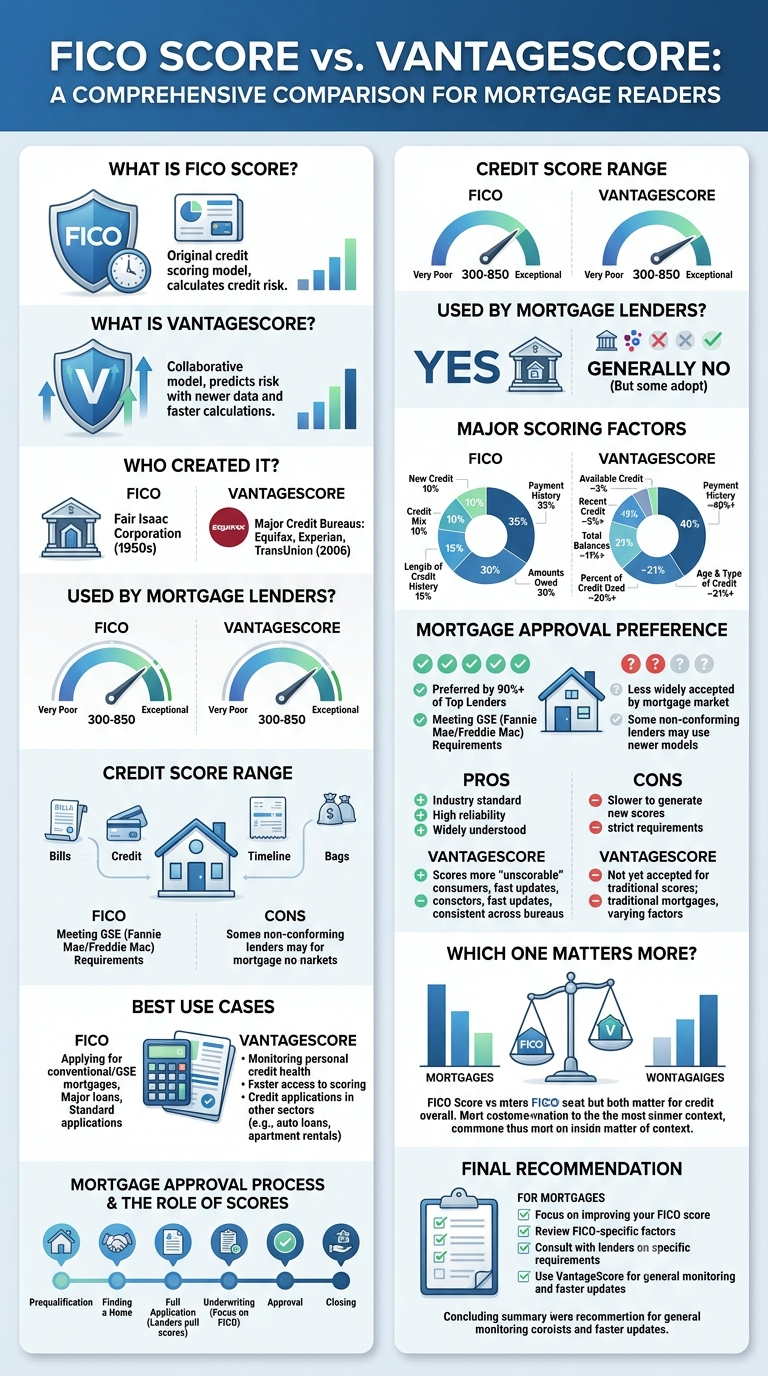
A FICO Score is a credit score developed by the Fair Isaac Corporation. It measures a consumer’s credit risk using information reported by the three nationwide credit bureaus. Scores generally range from 300 to 850, with higher scores indicating lower lending risk. Because of its long history and proven predictive accuracy, FICO has become the most widely used credit scoring model in the United States.
Mortgage lenders value FICO because it has been extensively tested across millions of loan files over several decades. The model provides lenders with a reliable way to estimate the likelihood that a borrower will repay a mortgage as agreed. Since mortgages involve large loan amounts and repayment periods that often extend to 15 or 30 years, lenders prioritize consistency and proven performance over newer alternatives.
Another advantage of FICO is that it offers industry-specific score versions. The score used for a credit card application may differ from the score used for an auto loan or mortgage. This industry customization allows lenders to evaluate applicants using models designed specifically for the type of credit being requested. Mortgage lenders typically rely on the older Classic FICO Scores because these models remain deeply integrated into underwriting systems used throughout the housing finance industry.
For homebuyers, this distinction is crucial. Seeing a FICO Score through a banking app does not necessarily mean it matches the mortgage score your lender will pull. Different versions of FICO exist, and mortgage underwriting commonly relies on FICO Score 2 (Experian), FICO Score 5 (Equifax), and FICO Score 4 (TransUnion) rather than newer consumer versions.
How FICO Scores Are Calculated
Although FICO does not publicly disclose its exact algorithm, it has identified the primary categories that influence a credit score. Understanding these factors can help borrowers make informed financial decisions before applying for a mortgage.
| Credit Factor | Approximate Influence |
|---|---|
| Payment History | 35% |
| Amounts Owed (Credit Utilization) | 30% |
| Length of Credit History | 15% |
| New Credit | 10% |
| Credit Mix | 10% |
Payment history carries the greatest weight. Making every payment on time demonstrates reliability and significantly strengthens your mortgage profile. Even a single late payment can lower your score, especially if it remains unpaid for an extended period.
Credit utilization measures how much revolving credit you’re using compared to your available credit limits. For example, using $2,000 of a $10,000 credit limit results in a 20% utilization ratio. Lower utilization generally reflects responsible credit management, and many mortgage professionals recommend keeping utilization below 30%, with even lower percentages often producing stronger results.
Length of credit history rewards borrowers who have managed accounts responsibly over many years. Closing older accounts unnecessarily can reduce the average age of your credit history, which may negatively affect your score.
New credit inquiries also matter. Applying for multiple new loans or credit cards within a short period can temporarily reduce your score because lenders may interpret frequent borrowing as increased financial risk. Finally, maintaining a healthy credit mix, such as responsibly managing installment loans and revolving accounts, demonstrates experience handling different types of debt.

Classic Mortgage FICO Scores (FICO 2, FICO 4, and FICO 5)
One of the biggest misconceptions among homebuyers is that there is only one FICO Score. In reality, FICO has developed numerous scoring models over the years, each designed for specific lending purposes. Mortgage lenders have traditionally relied on three older versions commonly known as the Classic FICO Scores.
These include:
| Credit Bureau | Mortgage Score Used |
|---|---|
| Experian | FICO Score 2 |
| TransUnion | FICO Score 4 |
| Equifax | FICO Score 5 |
Instead of selecting just one score, mortgage lenders typically obtain all three scores through a tri-merge credit report. In most cases, the lender uses the middle score when evaluating a single borrower. If two borrowers apply together, such as spouses purchasing a home jointly, the lender generally uses the lower middle score between the two applicants. This conservative approach helps lenders assess overall repayment risk more consistently.
Because these mortgage-specific versions differ from the scores available through many consumer apps, borrowers are often surprised when the lender’s score is lower—or occasionally higher—than expected. Preparing for this possibility can help avoid surprises during the mortgage application process.
What Is a VantageScore?
VantageScore is a credit scoring model created collaboratively by Experian, Equifax, and TransUnion. Introduced in 2006, it was designed to compete with FICO while expanding credit access to more consumers, including those with shorter or less traditional credit histories.
Like FICO, VantageScore generally uses a range of 300 to 850, making the numbers appear similar. However, the underlying calculations differ. VantageScore can often generate a score for consumers with limited credit histories sooner than FICO, making it useful for lenders serving borrowers who are newer to credit.
One reason VantageScore has become popular is its widespread availability. Many banks, credit card issuers, and personal finance platforms provide free VantageScores through online dashboards. As a result, millions of Americans monitor their VantageScore regularly without realizing that a mortgage lender may evaluate them using an entirely different scoring model.
Although VantageScore has gained significant acceptance in auto lending, personal loans, and credit card underwriting, its role in the mortgage market has historically been more limited. Recent policy changes have begun opening the door for broader mortgage use in certain situations, but many lenders continue relying on Classic FICO Scores because those models have decades of mortgage-specific performance data behind them.
How Does VantageScore Work?
VantageScore evaluates many of the same credit behaviors as FICO, but it places slightly different emphasis on certain factors and updates its methodology more frequently. This can produce noticeable score differences even when both models analyze the same credit report.
Some characteristics considered by VantageScore include:
- Payment history
- Credit utilization
- Total balances
- Age and type of credit accounts
- Recent credit activity
- Available credit
- Overall borrowing behavior
One feature that distinguishes VantageScore is its ability to score consumers with relatively limited credit histories. Earlier versions required less historical credit data than many FICO models, allowing more first-time borrowers to receive a score.
That said, consumers should remember that a higher VantageScore does not automatically improve mortgage eligibility. If a lender relies on Classic FICO Scores during underwriting, the mortgage decision will be based primarily on those scores rather than the VantageScore shown in a free credit monitoring app.
FICO Score vs VantageScore: Side-by-Side Comparison
| Feature | FICO Score | VantageScore |
|---|---|---|
| Introduced | 1989 | 2006 |
| Developed By | Fair Isaac Corporation | Experian, Equifax & TransUnion |
| Score Range | 300–850 | 300–850 |
| Used by Mortgage Lenders | Widely used | Limited but growing |
| Industry-Specific Versions | Yes | Limited |
| Free Consumer Access | Less common | Very common |
| Mortgage-Specific Scores | Yes (FICO 2, 4 & 5) | No traditional equivalent |
| Most Common Use | Mortgage, auto, credit cards | Credit monitoring, personal loans, credit cards |
Key takeaway: Both scoring models are valuable, but if you’re preparing to buy a home, understanding your mortgage-specific FICO Scores is generally more important than focusing solely on your VantageScore.
Which Credit Score Do Mortgage Lenders Actually Use?
If you’re preparing to buy a home, this is the question that matters most: Which credit score do mortgage lenders actually use?
For many years, the answer has been fairly consistent. Most U.S. mortgage lenders have relied on the Classic FICO Scores—specifically FICO Score 2 (Experian), FICO Score 5 (Equifax), and FICO Score 4 (TransUnion). These scores are pulled together through a tri-merge credit report, giving lenders a comprehensive view of your credit history across all three major credit bureaus.
For a single borrower, lenders generally use the middle of the three scores instead of the highest or lowest. For example:
| Bureau | Score |
|---|---|
| Experian (FICO 2) | 718 |
| Equifax (FICO 5) | 705 |
| TransUnion (FICO 4) | 730 |
Mortgage Score Used: 718
If two people apply together, such as spouses, the lender usually takes the middle score for each borrower and then uses the lower middle score to determine eligibility. This conservative approach helps lenders evaluate the overall repayment risk of the loan.
It’s also important to recognize that the mortgage industry is beginning to evolve. Federal housing regulators have approved a gradual transition that allows eligible loans to use VantageScore 4.0 alongside newer FICO models in certain circumstances. However, adoption is still in progress, and many lenders continue using the traditional Classic FICO Scores because their underwriting systems have relied on them for decades.
Bottom line: If you’re applying for a mortgage today, your mortgage-specific FICO Scores remain the most important credit scores to monitor, even if your bank or credit card app displays a VantageScore.
Why Mortgage Lenders Trust Classic FICO Scores?
Mortgages differ significantly from auto loans or credit cards. A lender isn’t approving a $5,000 credit limit—they’re often financing hundreds of thousands of dollars over 15 to 30 years. Because the financial risk is so much greater, lenders prefer scoring models with an extensive history of accurately predicting long-term mortgage repayment.
Classic FICO Scores have been used throughout the mortgage industry for decades. During that time, lenders have accumulated enormous amounts of historical performance data showing how borrowers with different scores performed after receiving home loans. That long record gives lenders confidence when making lending decisions.
Another reason is consistency. Mortgage underwriting systems, investor requirements, and secondary market guidelines were all built around these Classic FICO models. Changing to a completely different scoring system requires updating technology, risk models, compliance procedures, and investor standards—a process that takes time.
While newer scoring models may provide additional insights, most lenders prioritize stability. Until newer models become fully integrated across the mortgage industry, Classic FICO Scores are likely to remain the benchmark for many home loans.
Understanding the Tri-Merge Credit Report
Unlike many other lenders that review just one credit bureau, mortgage lenders typically order a tri-merge credit report. This report combines information from Experian, Equifax, and TransUnion into a single document.
A tri-merge report provides several advantages:
- It reduces the chance that missing information from one bureau will influence the lending decision.
- It gives lenders a more complete picture of the borrower’s credit profile.
- It helps identify inconsistencies or reporting errors.
- It allows lenders to compare three independent mortgage scores.
Rather than relying on one score, lenders review all available credit information before determining whether the applicant meets the required credit standards.
This approach explains why borrowers sometimes receive a different mortgage score than the one displayed in a free credit monitoring service. Consumer apps often display only one bureau and one scoring model, while mortgage lenders evaluate all three bureaus using mortgage-specific scoring models.
The Role of Experian, Equifax, and TransUnion
Many consumers mistakenly believe that Experian, Equifax, and TransUnion calculate credit scores. In reality, these companies are credit bureaus, not scoring companies.
Their primary responsibility is collecting and maintaining information reported by lenders, including:
- Credit card balances
- Mortgage accounts
- Auto loans
- Personal loans
- Payment history
- Collections
- Public records (where applicable)
FICO and VantageScore then analyze this information using their own scoring formulas.
Because creditors don’t always report information to all three bureaus at the same time, each bureau’s report may contain slight differences. One bureau may show a recently paid credit card balance while another still displays last month’s balance. These timing differences can easily produce different credit scores.
For this reason, reviewing all three credit reports before applying for a mortgage is one of the smartest steps a homebuyer can take.
Why Are Your FICO and VantageScore Different?
One of the most common questions from borrowers is:
“Why is my VantageScore 742 but my mortgage FICO Score only 711?”
The answer usually comes down to several factors working together.
Different Scoring Algorithms
FICO and VantageScore evaluate credit information differently. Even though both models consider similar financial behaviors, they assign different levels of importance to each factor.
Different Score Versions
Your banking app may show VantageScore 3.0, while your mortgage lender uses FICO Score 2, 4, or 5. Since these are completely different models, identical scores shouldn’t be expected.
Different Bureau Data
Experian, Equifax, and TransUnion may receive updated information on different dates.
Timing
Paying off a large credit card balance yesterday doesn’t guarantee every bureau has updated that information today.
These differences are completely normal and rarely indicate a problem with your credit profile.
The Five Credit Factors That Matter Most
Although every scoring model has its own methodology, several core factors consistently influence mortgage approval.
1. Payment History
Payment history is the single most important factor in nearly every credit scoring model.
Late payments, collections, charge-offs, and bankruptcies can significantly reduce your score. Conversely, a long history of on-time payments demonstrates financial responsibility and gives lenders confidence that you’ll make mortgage payments consistently.
Setting up automatic payments, monitoring due dates, and resolving delinquent accounts before applying can have a meaningful impact on your mortgage readiness.
2. Credit Utilization
Credit utilization measures how much revolving credit you’re using compared to your available credit limits.
Example:
- Credit Limit: $10,000
- Current Balance: $2,000
- Utilization: 20%
Lower utilization generally reflects responsible credit management. While there isn’t a universal threshold, many financial professionals recommend keeping utilization below 30%, with even lower percentages often supporting stronger credit profiles.
Paying down balances before your statement closing date can sometimes improve your reported utilization relatively quickly.
3. Length of Credit History
A longer credit history provides lenders with more information about how you’ve managed credit over time.
Older accounts that remain in good standing often strengthen your profile because they increase the average age of your credit history.
Before closing an old credit card, consider whether doing so could reduce your available credit or shorten your average account age, both of which may influence your credit score.
4. Hard Credit Inquiries
Every time you formally apply for new credit, a hard inquiry may appear on your credit report.
A single inquiry usually has only a small temporary effect.
However, opening several new credit cards or financing multiple large purchases shortly before applying for a mortgage may raise concerns about increasing debt obligations.
Mortgage applicants are generally advised to avoid unnecessary credit applications in the months leading up to their home loan application.
5. Credit Mix
Credit mix refers to the variety of credit accounts you manage.
Examples include:
- Credit cards
- Auto loans
- Student loans
- Personal loans
- Mortgages
A healthy mix demonstrates experience managing different forms of credit responsibly.
However, borrowers should never open unnecessary accounts solely to improve credit mix. Responsible financial management always outweighs simply having additional accounts.
How These Factors Affect Mortgage Approval?
Credit scores don’t determine mortgage approval by themselves.
Lenders evaluate your entire financial profile, including:
- Credit score
- Debt-to-income (DTI) ratio
- Income stability
- Employment history
- Down payment
- Cash reserves
- Property appraisal
- Loan type
For example, a borrower with a 680 credit score, stable employment, low debt, and a sizable down payment may receive approval more easily than someone with a 730 score but excessive debt and inconsistent income.
This is why improving your overall financial profile—not just your credit score—can significantly strengthen your mortgage application.
Minimum Credit Score Requirements by Loan Type
One of the biggest misconceptions among homebuyers is that there’s a single credit score requirement for every mortgage. In reality, the minimum score depends on the loan program, the lender’s internal underwriting guidelines, your debt-to-income (DTI) ratio, down payment, and overall financial profile. While government-backed loans generally offer more flexibility, conventional and jumbo loans often require stronger credit.
It’s also important to remember that the minimum qualifying score isn’t always the score needed to get the best deal. Borrowers with higher credit scores typically qualify for lower interest rates, smaller monthly payments, and reduced borrowing costs over the life of the loan.
The table below provides general industry ranges. Individual lender requirements may vary.
| Loan Type | Typical Minimum Credit Score* | Best For |
|---|---|---|
| Conventional Loan | 620+ | Borrowers with good credit and stable income |
| FHA Loan | 580+ (or lower with additional requirements) | First-time homebuyers and borrowers rebuilding credit |
| VA Loan | No official VA minimum; many lenders prefer around 620 | Eligible veterans, active-duty military, and certain surviving spouses |
| USDA Loan | No official USDA minimum; many lenders often prefer around 640 | Qualified rural homebuyers |
| Jumbo Loan | Often 700–740+ | High-value home purchases |
*Actual lender overlays and program requirements may differ.
Conventional Loan Credit Score Requirements
Conventional mortgages are among the most popular home loan options because they offer competitive interest rates and flexible loan terms for qualified borrowers. Unlike FHA or VA loans, conventional loans are not directly insured by the federal government, which means lenders often place greater emphasis on the applicant’s credit profile.
Many lenders look for a minimum credit score of around 620, but approval depends on much more than that number alone. A borrower with a 620 score and a low DTI ratio, stable employment, and a solid down payment may qualify, while another borrower with the same score but high debt and inconsistent income could face additional scrutiny.
Borrowers with scores of 740 or higher generally receive the most competitive pricing, though rate adjustments depend on many factors, including loan size, occupancy type, and market conditions.
FHA Loan Credit Score Requirements
FHA loans are designed to make homeownership more accessible, particularly for first-time buyers and borrowers with less-than-perfect credit. Because these loans are insured by the Federal Housing Administration, lenders may be willing to work with applicants who don’t qualify for conventional financing.
Many lenders accept borrowers with credit scores around 580 or higher for maximum financing, although some lenders may approve lower scores if additional conditions are met, such as a larger down payment or compensating financial factors.
Even if you meet the minimum score requirement, improving your credit before applying can still make a meaningful difference. A higher score may increase lender confidence and potentially improve your financing options.
VA Loan Credit Score Requirements
VA loans provide exceptional benefits for eligible veterans, active-duty service members, and certain surviving spouses. One of the biggest advantages is that the Department of Veterans Affairs does not establish a nationwide minimum credit score.
However, individual lenders are free to set their own underwriting standards. In practice, many lenders prefer applicants with scores around 620 or higher, although some may approve borrowers outside that range depending on the overall financial picture.
VA underwriting also considers factors such as residual income, employment stability, and debt obligations. As a result, borrowers with modest credit scores but otherwise strong financial profiles may still qualify.
USDA Loan Credit Score Requirements
USDA loans help eligible buyers purchase homes in qualifying rural and suburban communities. Like the VA program, the USDA itself does not establish a universal minimum credit score.
Many lenders, however, commonly look for scores around 640 to streamline the approval process. Applicants below that threshold may still qualify through manual underwriting if they demonstrate stable income, responsible payment history, and sufficient financial reserves.
Because eligibility also depends on income limits and property location, borrowers should verify program requirements before beginning the application process.
Jumbo Loan Credit Score Requirements
Jumbo loans finance properties that exceed conforming loan limits established for conventional mortgages. Since these loans involve larger balances and greater lender risk, underwriting standards are generally more stringent.
Many lenders expect applicants to have credit scores in the 700 to 740+ range, although exact requirements vary. In addition to strong credit, borrowers often need:
- Low debt-to-income ratios
- Significant cash reserves
- Stable, well-documented income
- Larger down payments
- Extensive financial documentation
For luxury home purchases, a strong credit profile becomes even more important because it helps demonstrate long-term financial stability.
How Credit Scores Affect Mortgage Interest Rates?
Your credit score doesn’t simply determine whether you qualify—it can significantly influence how much your mortgage costs over time.
In general, borrowers with stronger credit profiles are viewed as lower risk. That often translates into more favorable loan pricing. On the other hand, applicants with weaker credit may receive higher rates or be asked to satisfy additional underwriting conditions.
For example:
| Credit Range | Typical Lending Outcome |
|---|---|
| 760+ | Often eligible for the most competitive pricing |
| 700–759 | Generally strong financing options |
| 660–699 | May qualify, but pricing could be less favorable |
| 620–659 | Approval possible depending on the loan program and overall profile |
| Below 620 | Options become more limited, especially for conventional financing |
Even a modest difference in interest rate can affect the total amount paid over the life of a 30-year mortgage. That’s why many prospective buyers spend several months improving their credit before applying.
Real-World Case Study: Two Borrowers, Two Different Outcomes
Let’s compare two hypothetical first-time homebuyers applying for similar mortgage amounts.
Borrower A
- Mortgage FICO Score: 775
- Debt-to-Income Ratio: 30%
- Stable employment for five years
- 20% down payment
- No late payments in the past seven years
Borrower A demonstrates consistent financial management. Their strong credit history, moderate debt, and sizable down payment make them an attractive lending candidate. As a result, they are likely to qualify for competitive financing options.
Borrower B
- Mortgage FICO Score: 635
- Debt-to-Income Ratio: 46%
- Several recent late payments
- Multiple new credit card accounts opened within six months
- 5% down payment
Borrower B may still qualify for certain mortgage programs, particularly government-backed loans, but the application presents more risk. The lender may require additional documentation, closer underwriting review, or different loan terms based on the overall financial profile.
The Lesson
Notice that the difference isn’t just the credit score.
Mortgage lenders evaluate:
- Income stability
- Debt obligations
- Credit history
- Down payment
- Cash reserves
- Employment history
A mortgage approval is based on the complete financial picture, not one number alone.
Common Credit Mistakes Before Applying for a Mortgage
Many borrowers unintentionally reduce their approval chances by making avoidable financial decisions shortly before applying for a home loan.
Some of the most common mistakes include:
Opening New Credit Cards
Every new application may generate a hard inquiry and increase your available debt obligations. Unless absolutely necessary, it’s often wise to avoid opening new accounts before mortgage underwriting.
Financing Large Purchases
Buying a vehicle, furniture, or expensive electronics before closing on a home can increase your monthly debt payments and affect your debt-to-income ratio.
Missing Even One Payment
A single late payment can negatively impact your credit profile, especially if it occurs just before applying for a mortgage.
Closing Old Credit Accounts
Closing long-established credit cards may reduce your available credit and shorten your average account age, potentially affecting your score.
Ignoring Credit Report Errors
Mistakes happen.
Review your credit reports before applying and dispute any inaccurate information that could unnecessarily lower your credit score.
How to Improve Your FICO Score Before Applying for a Mortgage
If you’re planning to buy a home within the next few months, taking a structured approach to improving your credit can strengthen your mortgage application.
30-Day Plan
- Review all three credit reports.
- Dispute inaccurate information.
- Bring any past-due accounts current.
- Pay down high credit card balances where possible.
- Set up automatic payments to avoid future late payments.
60-Day Plan
- Continue reducing revolving balances.
- Avoid applying for new credit.
- Keep existing accounts open unless there’s a compelling reason to close them.
- Monitor your progress through reputable credit monitoring services.
90-Day Plan
- Maintain low credit utilization.
- Make every payment on time.
- Avoid large financed purchases.
- Save additional funds for your down payment and emergency reserves.
- Consult your mortgage lender about pre-approval and any remaining qualification steps.
Remember, credit improvement is usually gradual. Consistent financial habits often produce more sustainable results than attempting quick fixes or credit repair schemes that promise unrealistic outcomes.
Expert Mortgage Tips for First-Time and Repeat Homebuyers
Preparing for a mortgage involves much more than checking your credit score. Successful borrowers typically spend several months strengthening their overall financial profile before submitting an application. While every lender has unique underwriting guidelines, the following best practices can improve your chances of receiving favorable loan terms.
1. Know Your Mortgage FICO Scores
Many consumers monitor the score displayed by their bank or credit card provider, but that score may not be the version a mortgage lender reviews. If you’re serious about buying a home, ask your lender or a reputable credit provider about your mortgage-specific FICO Scores, so you know where you stand before applying.
2. Save Beyond the Down Payment
Many buyers focus exclusively on saving for the down payment. However, lenders also consider whether you have enough money for:
- Closing costs
- Moving expenses
- Emergency savings
- Property taxes
- Homeowners insurance
- Initial maintenance and repairs
Having additional cash reserves demonstrates financial stability and may strengthen your mortgage application.
3. Keep Your Debt-to-Income Ratio Healthy
Even borrowers with excellent credit scores can face challenges if they carry excessive monthly debt. Paying down credit cards, avoiding unnecessary loans, and increasing income where possible can improve your debt-to-income (DTI) ratio before applying.
4. Don’t Change Jobs Without Careful Planning
A stable employment history helps lenders evaluate your ability to make future mortgage payments. While changing jobs doesn’t automatically prevent approval, switching employers or industries shortly before applying may require additional documentation.
5. Avoid Major Financial Changes Before Closing
Once your mortgage is approved, avoid making significant financial decisions until after closing. Examples include:
- Financing a new vehicle
- Opening additional credit cards
- Taking out personal loans
- Making unusually large bank transfers
- Co-signing for someone else’s loan
Lenders may perform a final review before funding the loan, and unexpected changes could affect the approval.
Myths vs. Facts About Mortgage Credit Scores
Many homebuyers rely on outdated advice from friends, social media, or online forums. Separating myths from facts can help you make better financial decisions.
| Myth | Fact |
|---|---|
| Mortgage lenders use the same score shown in every banking app. | Mortgage lenders often use mortgage-specific Classic FICO Scores, which may differ from consumer scores. |
| Checking your own credit score lowers it. | Reviewing your own credit is generally considered a soft inquiry and does not affect your score. |
| You need perfect credit to buy a house. | Many borrowers qualify with good—or even fair—credit depending on the loan program and overall financial profile. |
| Paying off every credit card immediately guarantees a huge score increase. | Paying down balances can help, but improvements depend on multiple credit factors. |
| Closing old credit cards always improves your credit. | Closing older accounts may reduce available credit and shorten your average account age. |
| One late payment doesn’t matter. | Even a single missed payment can negatively affect your credit profile and mortgage application. |
| Every lender has identical credit score requirements. | Individual lenders may establish stricter standards than minimum program guidelines. |
| A higher score guarantees mortgage approval. | Credit score is important, but lenders also evaluate income, employment, debt, assets, and other underwriting factors. |
Understanding these realities allows borrowers to focus on the financial habits that genuinely improve mortgage readiness.
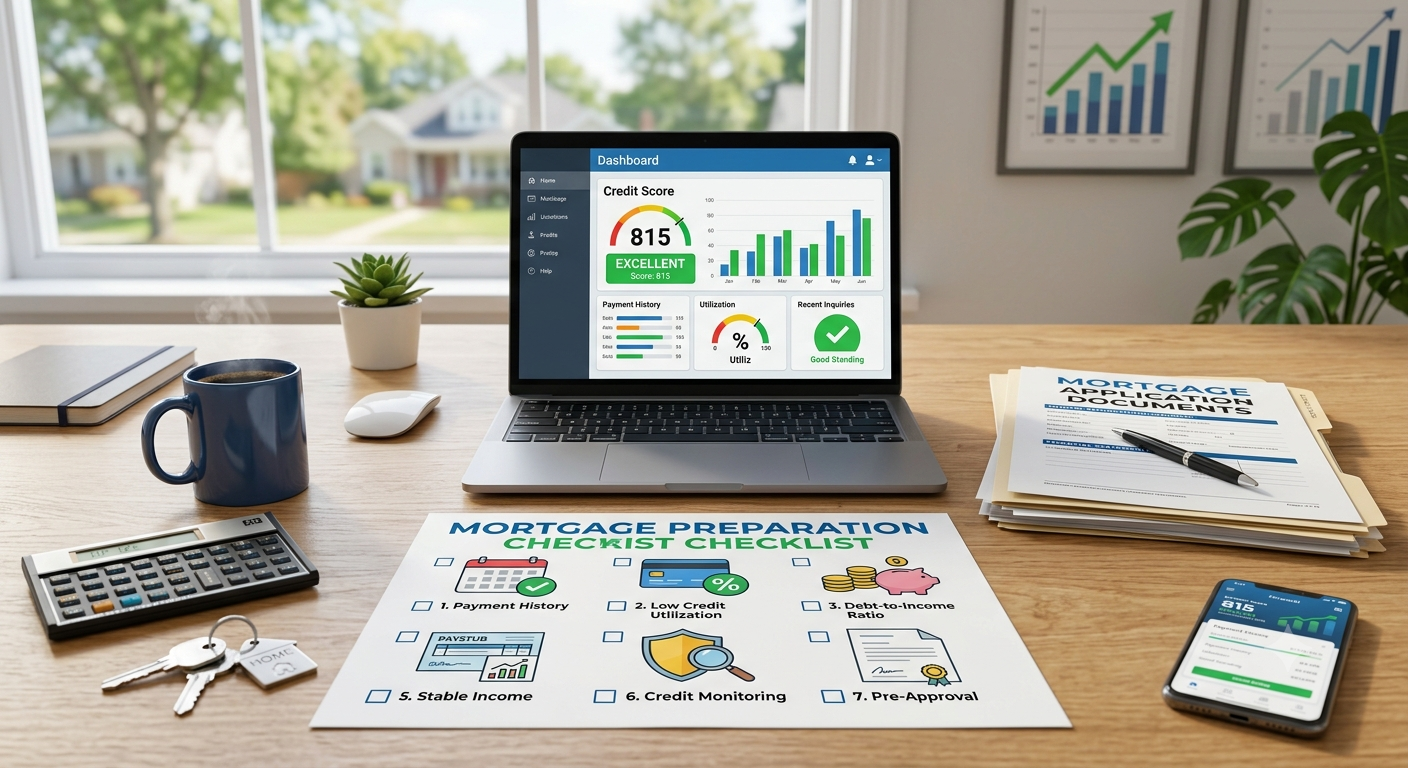
Mortgage Application Checklist
Before applying for a home loan, use this checklist to ensure you’re financially prepared.
Credit Preparation
- ☐ Review all three credit reports.
- ☐ Check your mortgage-specific FICO Scores if available.
- ☐ Dispute any inaccurate information.
- ☐ Make all payments on time.
- ☐ Reduce revolving credit balances where possible.
Financial Preparation
- ☐ Save for your down payment.
- ☐ Budget for closing costs.
- ☐ Maintain emergency savings.
- ☐ Avoid taking on unnecessary new debt.
- ☐ Gather income documentation.
Employment and Documentation
- ☐ Verify employment history.
- ☐ Collect recent pay stubs.
- ☐ Prepare W-2s or tax returns if required.
- ☐ Organize bank statements.
- ☐ Document additional income sources, if applicable.
Before Closing
- ☐ Avoid financing major purchases.
- ☐ Avoid opening new credit accounts.
- ☐ Continue making every payment on time.
- ☐ Stay in contact with your lender.
- ☐ Respond promptly to underwriting requests.
Completing this checklist before beginning the mortgage process can reduce delays and help create a smoother home-buying experience.
When VantageScore Still Matters
Although Classic FICO Scores remain the primary credit scores used by many mortgage lenders, VantageScore still serves an important purpose in the broader financial marketplace.
Many financial institutions provide VantageScore through online banking platforms because it gives consumers convenient access to ongoing credit monitoring. Watching your VantageScore can help you identify meaningful changes in your overall credit health, such as rising balances, missed payments, or newly reported accounts.
VantageScore is also widely used by some:
- Credit card issuers
- Personal loan lenders
- Auto finance companies
- Tenant screening services
- Consumer credit monitoring platforms
In addition, recent regulatory developments have opened the possibility for broader mortgage use of newer scoring models, including VantageScore 4.0, in certain segments of the housing finance system. However, implementation is gradual, and many lenders continue relying on Classic FICO Scores while technology, underwriting systems, and investor requirements evolve.
For today’s homebuyers, the practical takeaway is simple:
- Monitor your VantageScore regularly to stay informed about your overall credit health.
- Before applying for a mortgage, understand which scoring model your lender will actually use.
Knowing both scores provides a more complete picture of your financial stan
Future Trends in Mortgage Credit Scoring
The mortgage industry continues to evolve as technology advances and policymakers seek to expand responsible access to homeownership.
Several trends are shaping the future of mortgage credit evaluation.
Broader Acceptance of New Scoring Models
Federal housing finance agencies have begun supporting the gradual adoption of newer credit scoring models, including more recent FICO versions and VantageScore 4.0, for certain mortgage transactions. Adoption will likely occur over several years rather than overnight.
Improved Credit Data
Newer scoring models can incorporate more recent consumer credit behaviors and may provide a more comprehensive view of a borrower’s financial profile than older scoring systems.
Increased Automation
Mortgage underwriting increasingly combines credit scores with automated income verification, employment verification, asset validation, and fraud detection technologies. This allows lenders to evaluate applications more efficiently while maintaining lending standards.
Greater Financial Inclusion
Modern credit scoring models are designed to evaluate more consumers, including individuals with limited traditional credit histories. This could expand access to responsible home financing for qualified borrowers who previously had difficulty generating a credit score.
Continued Importance of Responsible Credit Habits
Even as scoring models evolve, the fundamentals remain largely unchanged.
Borrowers who consistently:
- Pay bills on time,
- Keep debt manageable,
- Avoid excessive borrowing,
- Maintain stable financial habits,
will continue to be well-positioned regardless of which scoring model becomes more widely adopted.
Key Takeaways: FICO Score vs VantageScore
- FICO and VantageScore are both legitimate credit scoring models, but they are calculated differently and may produce different scores for the same borrower.
- Many mortgage lenders continue to rely on Classic FICO Scores (FICO 2, FICO 4, and FICO 5) when evaluating home loan applications.
- Mortgage lenders typically review a tri-merge credit report containing information from Experian, Equifax, and TransUnion.
- Payment history, credit utilization, length of credit history, new credit inquiries, and credit mix remain the most influential credit factors.
- Your credit score is only one part of the mortgage approval process. Lenders also consider income, debt-to-income ratio, employment history, assets, down payment, and overall financial stability.
- Improving your credit several months before applying may increase your chances of qualifying for more favorable mortgage terms.
- Monitoring your VantageScore is still valuable for tracking your overall credit health, even if your lender ultimately relies on mortgage-specific FICO Scores.
- Because lending standards differ, always confirm your lender’s current credit score requirements before submitting a mortgage application.
Conclusion
Choosing between FICO Score vs VantageScore isn’t really about deciding which one is “better.” Both are legitimate credit scoring models that help lenders evaluate credit risk, but they serve different purposes. The key for homebuyers is understanding which score your mortgage lender actually uses.
For most mortgage applications in the United States, lenders have traditionally relied on the Classic FICO Scores—FICO Score 2 (Experian), FICO Score 5 (Equifax), and FICO Score 4 (TransUnion). Although newer scoring models, including VantageScore 4.0, are gradually entering the mortgage industry, widespread adoption will take time. That’s why it’s important to ask your lender which scoring model they’ll use before you begin shopping for a home.
If you’re planning to buy a house within the next few months, start preparing now. Review your credit reports from all three major credit bureaus, pay every bill on time, reduce revolving credit balances, avoid unnecessary debt, and maintain stable employment whenever possible. These habits don’t just improve your credit score—they strengthen your overall financial profile.
Remember, a mortgage approval isn’t based on one number alone. Lenders also evaluate your income, debt-to-income ratio, assets, employment history, down payment, and overall ability to repay the loan. By understanding how the mortgage process works and preparing in advance, you’ll be in a much stronger position to qualify for competitive financing and move confidently toward homeownership.
Frequently Asked Questions (FAQs)
1. What is the difference between FICO Score and VantageScore?
Both are credit scoring models that use information from your credit reports to predict lending risk. They use different algorithms, which is why the same borrower may receive different scores.
2. Which credit score do mortgage lenders use?
Many mortgage lenders traditionally use the Classic FICO Scores: FICO Score 2 (Experian), FICO Score 5 (Equifax), and FICO Score 4 (TransUnion). Some lenders may adopt newer approved models over time, so it’s best to confirm directly with your lender.
3. Can my VantageScore be higher than my FICO Score?
Yes. It’s common for VantageScore and FICO Score to differ because each model weighs credit information differently.
4. Why are my credit scores different across the three credit bureaus?
Creditors may report information to Experian, Equifax, and TransUnion at different times. Small differences in reported balances, payment dates, or account updates can result in different scores.
5. What FICO Score is used for mortgage approval?
Mortgage lenders have commonly used:
- FICO Score 2 (Experian)
- FICO Score 5 (Equifax)
- FICO Score 4 (TransUnion)
These are often referred to as the Classic FICO Scores.
6. Does checking my own credit score hurt it?
No. Checking your own credit score is generally considered a soft inquiry and does not lower your credit score.
7. What credit score is needed to buy a house?
The required score depends on the loan program and lender. Conventional loans often start around 620, while government-backed loans may have different guidelines. Higher scores generally provide access to more favorable financing terms.
8. How can I improve my FICO Score before applying for a mortgage?
Some effective strategies include:
- Paying every bill on time
- Reducing credit card balances
- Avoiding unnecessary new credit applications
- Correcting errors on your credit reports
- Maintaining older credit accounts in good standing
9. What is a tri-merge credit report?
A tri-merge report combines credit information from Experian, Equifax, and TransUnion into one report, allowing mortgage lenders to evaluate multiple credit scores during underwriting.
10. Does VantageScore matter for mortgage approval?
It can. While many lenders have historically relied on Classic FICO Scores, VantageScore remains important for monitoring your overall credit health and may become more widely used as mortgage industry standards evolve.
11. How does my credit score affect mortgage interest rates?
Borrowers with stronger credit profiles often qualify for lower interest rates, while lower scores may result in higher borrowing costs or additional underwriting requirements. Rates also depend on market conditions, loan type, down payment, and other financial factors.
12. Which credit bureau do mortgage lenders check?
Most mortgage lenders review information from all three major credit bureaus using a tri-merge credit report rather than relying on just one bureau.
13. Should I pay off all my credit cards before applying for a mortgage?
Reducing high credit card balances can strengthen your application, but paying off every account isn’t always necessary. Focus on maintaining low credit utilization, making payments on time, and keeping your overall financial profile healthy.
14. Can I qualify for a mortgage with fair credit?
Possibly. Many borrowers with fair credit qualify for mortgages, especially through certain government-backed loan programs. Approval depends on your entire financial profile, including income, debt-to-income ratio, employment history, and available assets.
15. What should I do before applying for mortgage pre-approval?
Before seeking Mortgage pre-approval:
- Review your credit reports.
- Check your mortgage-specific credit scores if available.
- Gather income and asset documentation.
- Reduce unnecessary debt.
- Avoid opening new credit accounts.
- Save for your down payment and closing costs.
- Compare offers from multiple lenders to find the best fit for your financial goals.
Final Thoughts
Understanding FICO Score vs VantageScore gives you a significant advantage as a homebuyer. Instead of relying solely on the score shown in a free credit monitoring app, focus on the scoring model your lender uses and build healthy financial habits well before submitting your application.
With careful preparation, realistic expectations, and a strong understanding of the mortgage process, you’ll be better equipped to secure financing that supports your long-term homeownership goals.
