
Buying a home is exciting—until you submit your mortgage application and begin waiting for an answer. One of the most common questions buyers ask is “How long does mortgage approval take?” The short answer is that most mortgage approvals in the United States take 30 to 45 days from a completed application to closing. In straightforward cases with strong credit, complete documentation, and an experienced lender, the process may finish in as little as two to three weeks. More complex applications, however, can take 45 to 60 days or longer, depending on underwriting, appraisal, and document verification.
The waiting period can feel stressful because several professionals work behind the scenes before your lender can issue a final approval. Your loan officer collects documents, processors verify information, underwriters evaluate risk, appraisers determine property value, and title companies prepare for closing. Understanding each stage helps eliminate uncertainty and allows you to prepare before delays occur. Whether you’re a first-time buyer, refinancing your current mortgage, or investing in real estate, knowing the typical mortgage approval timeline helps you plan with confidence.
What Is Mortgage Approval?
Mortgage approval is the lender’s decision that you qualify to borrow money for a home purchase. It doesn’t rely solely on your credit score. Instead, lenders evaluate your income, employment, assets, debts, property value, and overall financial stability before agreeing to fund the loan.
When you submit a mortgage application, your lender reviews information such as:
- Credit reports
- Employment verification
- Income documentation
- Tax returns (if applicable)
- Bank statements
- Debt-to-Income Ratio (DTI)
- Property appraisal
- Title review
Government-backed loan programs, including those supported by Fannie Mae & Freddie Mac, the Federal Housing Administration (FHA), the Department of Veterans Affairs (VA), and USDA Rural Development, each follow specific underwriting guidelines that may influence processing time.
Home Buyer Tip
Gather your financial documents before shopping for homes. Complete documentation is one of the easiest ways to reduce approval delays.
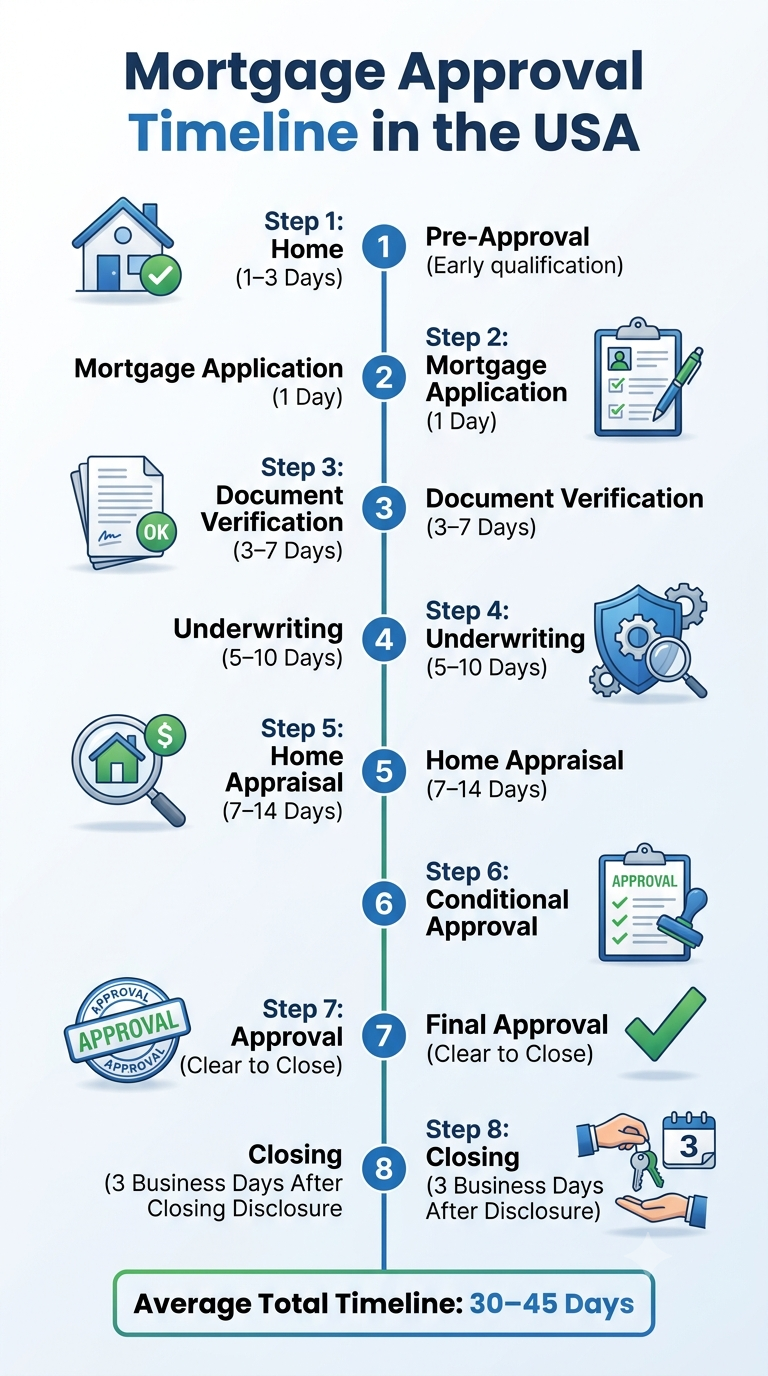
Average Mortgage Approval Timeline in the USA
While every transaction differs, the timeline below reflects what many borrowers experience today.
| Mortgage Stage | Typical Time |
|---|---|
| Pre-Approval | 1–3 days |
| Mortgage Application | 1 day |
| Document Verification | 3–7 days |
| Underwriting | 5–10 days |
| Home Appraisal | 1–2 weeks |
| Final Approval | 1–3 days |
| Closing | 3 business days after Closing Disclosure |
Federal rules also require borrowers to receive their Closing Disclosure at least three business days before closing, making this waiting period unavoidable.
For many conventional mortgages, buyers should expect approximately 30–45 days from an accepted offer to closing.
Expert Insight
Buyers often assume underwriting is the slowest step. In reality, waiting for appraisals, employment verification, or additional documentation frequently creates longer delays than underwriting itself.
Mortgage Pre-Approval Timeline
Getting pre-approved usually takes one to three business days, although some online lenders can issue preliminary decisions within hours if your financial profile is straightforward.
During pre-approval, lenders review:
- Income
- Assets
- Estimated debts
- Credit history
- Employment
A pre-approval letter demonstrates to sellers that you’re financially qualified, but it is not a final loan commitment. Many lenders issue letters that expire after 30 to 60 days, meaning buyers should avoid getting pre-approved too early if they are months away from house hunting.
Home Buyer Tip
Request pre-approvals from multiple lenders within a short shopping window. Credit scoring models generally treat multiple mortgage inquiries made during the same rate-shopping period as a single inquiry, minimizing the impact on your credit score.
What Happens During Mortgage Processing?
After you choose a property and formally apply, the real work begins.
Your loan processor verifies every document you submitted. If anything is missing, you’ll receive requests for additional paperwork known as conditions.
Typical verification includes:
- Pay stubs
- W-2s
- Tax returns
- Bank statements
- Gift funds
- Employment confirmation
- Identity verification
The lender is required to provide a Loan Estimate within three business days after receiving the required application information. Once you tell the lender you intend to proceed, processing moves forward with document collection, appraisal ordering, and underwriting.
Mortgage Underwriting Timeline
Underwriting is often viewed as the most critical stage of the mortgage approval process. This is where a mortgage underwriter reviews your entire financial profile to determine whether your loan meets the lender’s guidelines and, if applicable, the standards of organizations such as Fannie Mae, Freddie Mac, or government-backed programs.
In most cases, mortgage underwriting takes 5 to 10 business days. If your application is straightforward—with excellent credit, stable employment, and complete documentation—it may be completed in just a few days. On the other hand, self-employed borrowers, applicants with multiple income sources, or those purchasing unique properties may experience a longer review period.
During underwriting, the lender verifies:
- Your credit history and credit score
- Employment and income
- Debt-to-Income Ratio (DTI)
- Available assets and reserves
- Property appraisal
- Title report
- Insurance requirements
The underwriter will typically make one of four decisions:
| Decision | Meaning |
|---|---|
| Approved | Loan is ready for final steps. |
| Conditionally Approved | Additional documents are required before final approval. |
| Suspended | More information is needed before a decision can be made. |
| Denied | Loan does not meet lending requirements. |
Home Buyer Tip
Respond to underwriting requests within 24 hours whenever possible. Many unnecessary delays occur simply because borrowers wait several days before uploading requested documents.
Conditional Mortgage Approval
Receiving a conditional approval is actually good news. It means the lender intends to approve your mortgage once certain outstanding items are satisfied.
Common conditions include:
- Updated pay stubs
- Recent bank statements
- Letter explaining a large deposit
- Proof that a debt has been paid
- Homeowners insurance information
- Verification of employment
Many borrowers mistakenly believe conditional approval means something is wrong. In reality, it’s one of the most common stages of the mortgage loan approval process.
Once you satisfy every condition, the underwriter performs one final review before issuing Clear to Close, which is the final approval allowing your closing appointment to be scheduled.
Expert Insight
The faster you respond to conditions, the faster your lender can issue final approval. Waiting even two or three days to submit documents can easily extend closing by a week.
Home Appraisal Timeline
A home appraisal protects both the lender and the buyer by confirming that the property’s market value supports the loan amount.
Typically, the appraisal process takes:
| Stage | Average Time |
|---|---|
| Appraisal Ordered | 1–2 days |
| Property Inspection | 3–7 days |
| Report Delivery | 2–5 days |
| Underwriter Review | 1–3 days |
Overall, most appraisals take 7 to 14 days, although busy real estate markets or rural areas may require additional time.
If the appraised value comes in lower than the agreed purchase price, buyers may need to:
- Renegotiate with the seller
- Increase their down payment
- Challenge the appraisal
- Cancel the contract if protected by an appraisal contingency
Home Buyer Tip
Delays in scheduling appraisers are common during busy home-buying seasons. Choosing a lender that orders the appraisal immediately after receiving your signed disclosures can help keep your timeline on track.
Final Mortgage Approval Timeline
Once underwriting conditions have been satisfied and the appraisal has been accepted, the lender issues the final approval, often referred to as Clear to Close.
This stage usually takes one to three business days.
Before closing, your lender performs one final verification that may include:
- Employment verification
- Credit refresh
- Review of any new debts
- Confirmation that all loan conditions have been met
Because lenders often perform a final employment check shortly before closing, avoid changing jobs or leaving your current employer during the mortgage process unless you’ve discussed it with your lender.
How Long Does Closing Take?
After receiving final approval, federal regulations require lenders to provide borrowers with a Closing Disclosure at least three business days before closing.
During closing, you’ll:
- Review final loan documents
- Pay your down payment and closing costs
- Sign mortgage paperwork
- Transfer ownership
- Receive the keys once funding is complete
For many buyers, the closing appointment itself lasts between 60 and 90 minutes, although funding timelines can vary slightly depending on state requirements.
Mortgage Approval Timeline by Loan Type
Not all mortgage programs follow the same approval timeline.
| Loan Type | Typical Approval Time | Notes |
|---|---|---|
| Conventional Loan | 30–45 days | Usually the fastest option. |
| FHA Loan | 30–45 days | Additional property standards may apply. |
| VA Loan | 30–50 days | Requires VA eligibility verification. |
| USDA Loan | 35–60 days | USDA review can extend processing. |
| Jumbo Loan | 45–60+ days | Stricter underwriting requirements. |
Government-backed loans often involve additional documentation, but experienced lenders can still process them efficiently when borrowers submit complete paperwork.
Online Lenders vs. Traditional Banks
Technology has significantly changed the mortgage industry.
Online Mortgage Lenders
Advantages
- Faster digital applications
- Secure document uploads
- Automated income verification
- Real-time status tracking
- Often quicker approvals
Traditional Banks
Advantages
- Existing banking relationships
- In-person support
- Local loan officers
- Familiar branch network
Neither option is automatically better. Some online lenders close loans in under three weeks, while many community banks provide exceptional personalized service that keeps transactions moving smoothly.
Expert Insight
The speed of approval often depends more on the efficiency of the lender’s internal process than on whether the lender is online or branch-based.

Factors That Affect Mortgage Approval Speed
Several variables determine how quickly your mortgage moves from application to closing.
| Factor | Impact |
|---|---|
| Credit Score | Higher scores usually mean fewer underwriting concerns. |
| Debt-to-Income Ratio | Lower DTI improves approval speed. |
| Employment Verification | Stable employment reduces delays. |
| Income Documentation | Complete records accelerate processing. |
| Property Appraisal | Delays here affect the entire timeline. |
| Loan Program | Government-backed loans may require extra reviews. |
| Borrower Response Time | Slow document submission is a common cause of delays. |
Borrowers often focus only on credit scores, but lenders evaluate the complete financial picture before issuing final approval.
How to Speed Up Mortgage Approval?
Although you cannot control every part of the process, you can significantly improve your chances of a faster approval.
Here are practical ways to keep your application moving:
- Get pre-approved before shopping for homes.
- Upload all requested documents promptly.
- Avoid making large purchases.
- Don’t open new credit accounts.
- Keep enough cash available for closing.
- Respond to lender emails the same day.
- Avoid changing jobs during underwriting.
- Work with an experienced mortgage lender.
- Review your credit report before applying.
- Keep copies of all financial documents organized.
Home Buyer Tip
The borrowers who close fastest are usually the ones who prepare their paperwork before they even submit their mortgage application.
Can Mortgage Approval Happen in One Week?
Yes—but only in limited situations.
If you’ve ever heard someone say they closed on a home in seven days, it probably wasn’t a typical mortgage transaction. A one-week approval usually happens when several favorable factors come together:
- The borrower has an excellent credit score (740+).
- Income is easy to verify through W-2 employment.
- The down payment is already in the bank.
- The property appraisal is waived or completed quickly.
- The title search has no issues.
- The lender offers an expedited underwriting program.
- All requested documents are submitted immediately.
Even when these conditions are met, closing within seven days is still uncommon. Most buyers should realistically expect 30–45 days from application to closing.
⚠️ Warning
Be cautious of advertisements promising “guaranteed 7-day mortgage approval.” Approval depends on your financial profile, the property, and third-party services such as appraisals and title work.
Common Mistakes That Delay Mortgage Approval
Many delays are preventable. Here are some of the most common mistakes borrowers make during the mortgage process.
1. Changing Jobs
A new employer or a switch from salaried to self-employed income may require additional employment verification.
2. Opening New Credit Accounts
Buying furniture, appliances, or a new car before closing can increase your Debt-to-Income Ratio and may even change your loan eligibility.
3. Large Bank Deposits
Unexpected deposits often require documentation to prove where the money came from.
4. Missing Documents
One missing pay stub or bank statement can stop underwriting until it’s received.
5. Ignoring Your Loan Officer
Quick responses help keep your file moving through underwriting.
6. Making Large Cash Withdrawals
Significant changes in your bank account may require additional explanations.
7. Not Reviewing Your Credit Report
Unexpected errors can delay approval if discovered during underwriting.
Home Buyer Tip
Keep your finances as stable as possible from the day you apply until after closing.
Mortgage Approval After Underwriting
Many borrowers wonder:
“How long after underwriting comes final approval?”
If underwriting has already approved your file and you’ve satisfied every condition, final approval usually arrives within 1–3 business days.
The lender then issues what’s commonly called:
- Clear to Close (CTC)
Once you receive the Clear to Close, the lender prepares your Closing Disclosure and schedules your closing appointment.
For many buyers, this is the most exciting stage because nearly all major reviews have been completed.
What Happens After Mortgage Approval?
Receiving final approval doesn’t mean the process is completely over.
Before you receive the keys, several important steps still take place:
- Closing Disclosure is delivered.
- The three-business-day waiting period begins.
- The closing appointment is scheduled.
- Buyer signs loan documents.
- Down payment and closing costs are paid.
- Loan funds are released.
- Property ownership transfers.
- Keys are handed over.
In many states, funding occurs on the same day. In others, there may be a short delay before the deed is officially recorded.
Real-Life Mortgage Timeline Example
Here’s a realistic example of how the mortgage process may unfold for a first-time homebuyer.
| Day | Event |
|---|---|
| Day 1 | Mortgage application submitted |
| Day 2 | Credit check completed |
| Day 3 | Loan Estimate issued |
| Day 5 | Documents verified |
| Day 7 | Appraisal ordered |
| Day 12 | Property appraised |
| Day 16 | Appraisal received |
| Day 20 | Underwriting review |
| Day 23 | Conditional approval |
| Day 26 | Additional documents submitted |
| Day 28 | Final approval |
| Day 29 | Closing Disclosure sent |
| Day 33 | Closing appointment |
| Day 34 | Buyer receives keys |
This example reflects a relatively smooth transaction. Delays in appraisals, title work, or documentation can extend the timeline.
Latest Mortgage Approval Trends in the USA (2026)
Mortgage lending continues to evolve with technology, making many parts of the approval process faster than they were just a few years ago.
Current trends include:
- AI-assisted document verification.
- Digital income verification.
- Automated asset verification.
- Electronic signatures.
- Online borrower portals.
- Faster underwriting systems.
- Improved communication through mobile apps.
At the same time, lenders remain cautious about risk. Rising home prices, changing interest rates, and tighter underwriting standards mean borrowers still need strong documentation to qualify.
Complete Mortgage Approval Checklist
Before applying, make sure you have:
- ✅ Government-issued photo ID
- ✅ Social Security Number
- ✅ Last 30 days of pay stubs
- ✅ W-2 forms (last two years)
- ✅ Federal tax returns (if required)
- ✅ Bank statements (last two to three months)
- ✅ Investment account statements
- ✅ Employment information
- ✅ Rental history (if applicable)
- ✅ Gift letter (if receiving gift funds)
- ✅ Homeowners insurance quote
- ✅ Purchase agreement
- ✅ Down payment funds
- ✅ Closing cost funds
Having these documents ready before applying can significantly reduce delays.
Expert Tips for Faster Mortgage Approval
Experienced mortgage professionals often recommend the following:
- Check your credit several months before applying.
- Reduce unnecessary debt.
- Avoid financing large purchases.
- Save additional cash reserves.
- Maintain stable employment.
- Work with a responsive loan officer.
- Upload the requested documents immediately.
- Read every lender email carefully.
- Ask questions early rather than waiting.
- Keep copies of every financial document.
Preparation is often the difference between a smooth closing and weeks of unnecessary delays.
Common Mortgage Approval Myths
| Myth | Reality |
|---|---|
| Pre-approval guarantees the loan. | Final underwriting still determines approval. |
| Excellent credit guarantees approval. | Income, assets, and DTI also matter. |
| Every mortgage closes in 30 days. | Timelines vary by borrower and lender. |
| Conditional approval means bad news. | It’s a normal part of underwriting. |
| You can safely finance furniture before closing. | New debt can jeopardize approval. |
Frequently Asked Questions (FAQs)
1. How long does mortgage approval usually take?
Most mortgage approvals take 30 to 45 days from application to closing.
2. Can I get mortgage approval in one week?
It’s possible in rare situations, but most buyers should expect a longer timeline.
3. How long does underwriting take?
Typically 5–10 business days, depending on the complexity of your application.
4. What happens after conditional approval?
You’ll submit any requested documents, and the underwriter will review them before issuing final approval.
5. How long after the appraisal is final approval?
Usually a few days, provided the appraisal meets lender requirements and no additional conditions remain.
6. Can my mortgage still be denied after underwriting?
Yes. New debt, employment changes, or inaccurate information can still result in a denial before closing.
7. What is Clear to Close?
It means your lender has completed underwriting and approved your loan for closing.
8. How long does closing take?
The closing appointment itself usually lasts 60–90 minutes, but funding timelines vary by state.
9. What causes the biggest mortgage delays?
Incomplete documentation, appraisal issues, title problems, and slow borrower responses are among the most common causes.
10. How can I speed up mortgage approval?
Submit complete documentation, maintain stable finances, avoid new debt, and respond quickly to your lender.
Conclusion
The answer to “How Long Does Mortgage Approval Take?” depends on several moving parts, but most buyers can expect the process to take 30 to 45 days from application to closing. While some loans move much faster, others require extra time because of appraisals, underwriting conditions, employment verification, or additional documentation.
The best way to keep your mortgage on schedule is to prepare before you apply. Organize your financial documents, monitor your credit, avoid major financial changes, and stay in regular communication with your lender. Small steps taken early can prevent costly delays later and help make your path to homeownership much smoother.
