
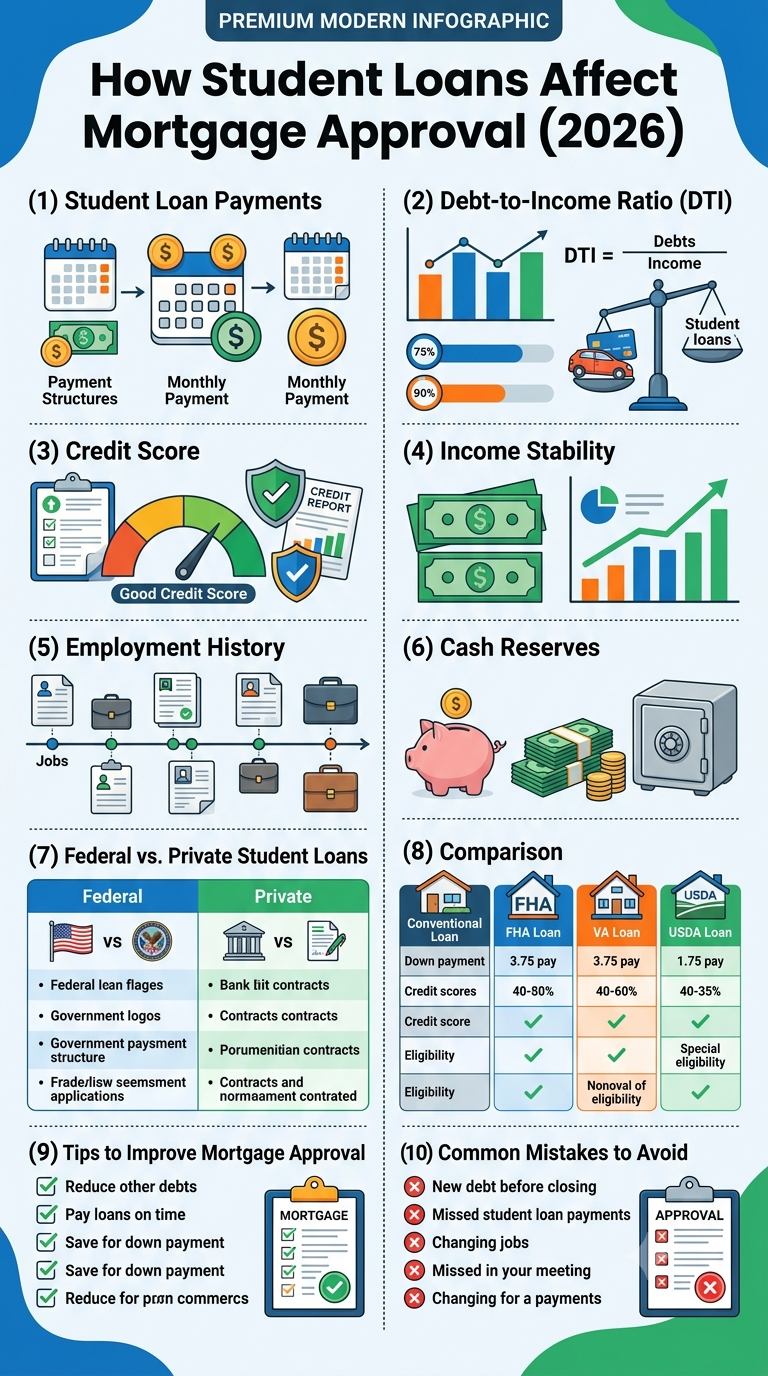
How Student Loans Affect Mortgage Approval: If you’re planning to buy a home, one of the biggest questions on your mind might be whether your student loans will hurt your chances of getting approved for a mortgage. The good news is that student loans don’t automatically disqualify you from buying a house. Instead, mortgage lenders look at how your student loan payments fit into your overall financial picture. They evaluate factors such as your debt-to-income (DTI) ratio, credit score, income stability, employment history, and monthly debt obligations to determine whether you can comfortably afford a mortgage. Even borrowers with substantial student loan balances can qualify if they have a high income, good credit, and manageable monthly payments.
Understanding how student loans influence the mortgage approval process can help you prepare before applying and avoid unnecessary surprises. Whether you have federal student loans, private student loans, or are enrolled in an income-driven repayment (IDR) plan, each situation may affect your mortgage application differently. In the following sections, we’ll explain how lenders calculate student loan payments, how deferred or forbearance loans are handled, and what practical steps you can take to improve your chances of securing a home loan while carrying student debt.
Can You Get a Mortgage with Student Loan Debt?
Sarah graduated from college five years ago with nearly $58,000 in federal student loans. She landed a stable job, built decent credit, and finally saved enough money for a down payment. Yet every time she browsed homes online, one question kept bothering her:
Can you get a mortgage with student loan debt?
If you’ve asked yourself the same thing, you’re far from alone.
Millions of Americans carry student loan balances while dreaming of buying their first home. The good news is that student loan debt alone does not prevent mortgage approval. Every day, borrowers with education debt successfully qualify for conventional, FHA, VA, and USDA mortgages.
Instead of focusing only on how much you owe, mortgage lenders evaluate your complete financial picture. Your income, debt-to-income ratio (DTI), credit history, employment stability, savings, and monthly obligations all play major roles in determining whether you qualify. Recent lending guidance also allows documented income-driven repayment amounts to be used in many cases, which can significantly improve affordability for eligible borrowers.
This guide explains exactly how student loans influence mortgage approval, what lenders evaluate in 2026, practical ways to improve your approval chances, and which mortgage programs may fit your situation best.
Can You Really Get a Mortgage With Student Loan Debt?
Short Answer
Yes.
Having student loans does not automatically prevent you from getting approved for a mortgage.
Many first-time buyers mistakenly assume lenders reject anyone with education debt. In reality, lenders approve thousands of borrowers every month who still owe federal or private student loans. The determining factor isn’t the total balance—it is whether your overall finances show you can comfortably manage another monthly payment.
Think of your finances like a puzzle. Student loans represent only one piece. A borrower with $80,000 in student debt but a six-figure salary, strong credit score, and manageable monthly obligations may qualify far more easily than someone with only $15,000 in loans but poor credit and unstable income.
Modern underwriting systems evaluate risk from several angles instead of relying on one number. Mortgage companies review your payment history, employment consistency, available savings, debt ratios, and documented income before making a lending decision.
Quick Answer:
Yes, you can get a mortgage with student loan debt. Mortgage lenders evaluate your debt-to-income ratio, credit score, income, employment history, savings, and overall financial profile—not just your student loan balance. A higher balance does not automatically mean your application will be denied.
Why Student Loans Don’t Automatically Disqualify You?
Years ago, lenders placed greater emphasis on debt balances. Today, underwriting focuses much more heavily on monthly affordability.
Imagine two borrowers:
| Borrower | Student Loan Balance | Monthly Payment | Annual Income |
|---|---|---|---|
| Alex | $120,000 | $250 | $145,000 |
| Mike | $20,000 | $700 | $52,000 |
Although Alex owes significantly more overall, his monthly payment consumes a much smaller percentage of his income. From a lender’s perspective, Alex may actually represent the lower financial risk.
That example highlights why the monthly payment often matters more than the total loan amount.
How Mortgage Lenders Evaluate Student Loan Debt?
Mortgage underwriting resembles a complete financial health check rather than a simple pass-or-fail test. Student loans are one factor among many.
Debt-to-Income Ratio (DTI)
The debt-to-income ratio (DTI) remains one of the most important approval factors.
DTI compares your required monthly debt payments against your gross monthly income.
For example:
- Gross Monthly Income: $7,000
- Student Loan Payment: $300
- Auto Loan: $450
- Credit Cards: $150
- Estimated Mortgage Payment: $2,000
Total Monthly Debt = $2,900
DTI = 41.4%
Most loan programs establish maximum DTI guidelines, although automated underwriting systems may approve higher ratios depending on compensating factors such as excellent credit, larger down payments, or substantial cash reserves.
Credit Score
Your student loans can influence your mortgage indirectly through your credit profile.
Making payments consistently demonstrates responsible borrowing behavior and may strengthen your credit history over time.
Late payments, defaults, collections, or missed student loan payments can reduce your credit score substantially, making mortgage approval more difficult or increasing your interest rate.
Mortgage lenders typically review:
- Payment history
- Length of credit history
- Credit utilization
- Recent credit inquiries
- Public records
- Overall credit management
This means student loans can actually help build strong credit when managed responsibly.
Income Stability
A high income often offsets concerns about student debt.
Lenders generally want evidence that your income is reliable and likely to continue. W-2 employees, government workers, healthcare professionals, engineers, teachers, and many salaried workers often present stable income profiles that underwriters favor.
Self-employed applicants may need additional documentation, including tax returns and business income records.
Rather than asking, “How much student debt do you have?” lenders often ask, “Can your current income comfortably support all of your monthly obligations?”
That distinction makes a tremendous difference for many first-time buyers.
Employment History
Employment consistency remains another important underwriting factor.
Many loan programs prefer a stable employment history, though changing jobs within the same profession doesn’t necessarily hurt your application.
For recent graduates, education can sometimes satisfy part of the employment history requirement when entering a career related to their degree, depending on the loan program and lender guidelines.
This is particularly helpful for young professionals who recently completed college and entered the workforce.
Cash Reserves
Savings provide lenders with additional confidence.
Having emergency reserves after closing demonstrates that unexpected expenses are less likely to jeopardize mortgage payments.
Cash reserves may include:
- Savings accounts
- Checking balances
- Retirement accounts (when eligible)
- Investment accounts
- Certain gift funds (subject to loan program rules)
A borrower with healthy reserves often appears financially stronger than someone purchasing a home with almost no money left after closing.

How Student Loans Affect Mortgage Approval?
Many homebuyers assume that having student loan debt automatically means they won’t qualify for a mortgage. In reality, mortgage lenders are much more concerned with how your student loans affect your monthly budget than with the total amount you borrowed. A borrower carrying $100,000 in student loans but making manageable monthly payments and earning a strong salary may qualify more easily than someone with a much smaller balance but a high debt-to-income (DTI) ratio. That’s because lenders focus on your ability to repay the mortgage alongside your existing financial obligations.
During the underwriting process, lenders review several factors related to your student loans, including your monthly payment amount, repayment plan, loan status, credit history, and whether your payments fit comfortably within your income. Understanding how each of these elements affects your mortgage application can help you prepare before applying.
Monthly Student Loan Payments Matter Most
The monthly payment reported on your credit report or loan documentation is one of the first things a mortgage lender evaluates. Rather than looking solely at the outstanding loan balance, lenders calculate how much of your gross monthly income is already committed to debt payments.
For example:
| Borrower | Student Loan Balance | Monthly Payment | Annual Income | Mortgage Outlook |
|---|---|---|---|---|
| Emily | $90,000 | $280 | $105,000 | Strong |
| David | $25,000 | $750 | $58,000 | May Need Lower DTI |
Although Emily owes considerably more, her lower monthly payment relative to her income creates a healthier debt profile.
Quick Answer: Mortgage lenders care more about your required monthly student loan payment than your total student loan balance because monthly obligations directly affect your debt-to-income ratio.
Income-Driven Repayment (IDR) Plans
Federal student loan borrowers enrolled in an Income-Driven Repayment (IDR) plan often have lower monthly payments based on their income and family size. This can improve mortgage affordability because the required payment may be significantly lower than it would be under a standard repayment schedule.
For many borrowers, an IDR plan reduces the amount counted toward monthly debt, making it easier to qualify for a mortgage. However, lenders generally require documentation showing the actual required payment, and individual lender guidelines may vary. Always verify current requirements with your loan officer before applying.
If your income increases substantially in the future, your IDR payment may also increase. While that does not affect today’s mortgage approval directly, it’s wise to consider how future payment changes could impact your household budget.
Deferred Student Loans
Some borrowers still have loans in deferment because they recently graduated, returned to school, or qualified for another deferment program. Even if payments are temporarily paused, mortgage lenders usually cannot ignore those loans entirely.
Instead, lenders follow the guidelines of the mortgage program they are using. If no payment appears on your credit report or loan documents, they may calculate a qualifying payment using program-specific rules. This prevents borrowers from appearing to have less debt simply because payments are temporarily suspended.
If you’re planning to buy a home while your loans are deferred, discuss your repayment plans with your lender early in the process. Providing updated documentation may help the underwriter accurately evaluate your financial obligations.
Student Loan Forbearance
Forbearance allows borrowers to temporarily pause or reduce student loan payments during periods of financial hardship. While this can provide short-term relief, it doesn’t eliminate the debt.
Mortgage lenders understand that borrowers may have entered forbearance for legitimate reasons, but they still need to determine your future payment obligation. In many cases, they will calculate an estimated monthly payment if one isn’t currently required.
If you’ve recently exited forbearance and resumed making payments, maintaining an on-time payment history before applying for a mortgage can strengthen your application.
Federal vs. Private Student Loans
Both federal and private student loans count as debt during the mortgage approval process, but they differ in several important ways.
| Feature | Federal Student Loans | Private Student Loans |
|---|---|---|
| Government-backed | Yes | No |
| Income-driven repayment options | Available for eligible borrowers | Usually not available |
| Deferment and forbearance programs | More flexible | Varies by lender |
| Repayment flexibility | Generally higher | Depends on loan terms |
Federal loans often provide more repayment flexibility, which may help borrowers maintain affordable monthly payments. Private loans, on the other hand, may have fixed repayment schedules and fewer hardship options.
Regardless of the loan type, lenders evaluate your current payment obligation, credit history, and overall financial profile rather than making decisions based solely on whether the loan is federal or private.
Student Loan Rules by Mortgage Program
Different mortgage programs have different underwriting guidelines. Understanding these differences can help you choose the loan that best fits your financial situation.
| Mortgage Program | Down Payment | Student Loan Evaluation | Best For |
|---|---|---|---|
| Conventional Loan | As low as 3% | Reviews documented monthly payment and DTI | Borrowers with strong credit |
| FHA Loan | 3.5% | Flexible credit standards but considers student loan obligations | First-time homebuyers |
| VA Loan | Often 0% | Evaluates overall ability to repay | Eligible veterans and service members |
| USDA Loan | Often 0% | Reviews DTI and repayment capacity | Eligible rural homebuyers |
Conventional Loans
Conventional loans generally offer competitive interest rates for borrowers with solid credit scores and stable income. Lenders carefully evaluate your debt-to-income ratio, including student loan payments, but strong financial factors—such as a larger down payment or significant savings—may improve your approval chances.
FHA Loans
FHA loans are popular among first-time homebuyers because they offer more flexible credit requirements and lower down payments. Borrowers with student loans often find FHA financing attractive if they meet the program’s income and DTI requirements.
VA Loans
VA loans are available to eligible veterans, active-duty service members, and certain surviving spouses. They often require no down payment and no private mortgage insurance (PMI). Student loan debt is still considered, but lenders focus on whether your remaining income is sufficient to cover housing expenses and other obligations.
USDA Loans
USDA loans are designed for eligible rural and suburban homebuyers. They provide affordable financing with no down payment for qualified applicants. Student loan debt is included in the underwriting process, but overall affordability and debt management remain the primary considerations.
Expert Tip
Before applying for a mortgage, request a copy of your credit report, review your current student loan payment, calculate your debt-to-income ratio, and speak with a knowledgeable loan officer. Small improvements—such as paying off a credit card balance or correcting an error on your credit report—can make a meaningful difference in your approval chances.
How to Improve Your Chances of Mortgage Approval With Student Loan Debt?
Carrying student loan debt doesn’t mean you have to postpone your dream of homeownership. In fact, many successful homebuyers qualify for mortgages every year while still repaying student loans. The key is understanding what lenders want to see and taking proactive steps to strengthen your financial profile before submitting your application.
Even small improvements can make a noticeable difference. Lowering your debt-to-income ratio by just a few percentage points, increasing your credit score by 20–30 points, or saving a larger down payment may help you qualify for better loan terms and a lower interest rate.
1. Improve Your Credit Score
Your credit score is one of the first things mortgage lenders review because it reflects how responsibly you’ve managed debt over time.
Here are several ways to improve your score before applying:
- Pay every bill on time.
- Keep credit card balances below 30% of your available credit limit.
- Avoid applying for unnecessary credit cards or personal loans.
- Review your credit reports for errors and dispute any inaccuracies.
- Continue making your student loan payments on time.
Even if your score isn’t perfect, demonstrating consistent financial responsibility over several months can strengthen your mortgage application.
Expert Tip: Avoid closing old credit cards unless necessary. A longer credit history can positively impact your credit score.
2. Reduce Other Monthly Debt
While student loans may be unavoidable, other debts often can be reduced before applying for a mortgage.
Consider paying down:
- Credit card balances
- Personal loans
- Auto loans (if possible)
- Buy Now, Pay Later (BNPL) accounts
- High-interest consumer debt
Reducing these obligations lowers your debt-to-income ratio, which is one of the biggest factors lenders evaluate.
3. Increase Your Down Payment
Although many mortgage programs allow low down payments, contributing more upfront can improve your overall loan profile.
Benefits of a larger down payment include:
- Lower monthly mortgage payment
- Lower loan amount
- Reduced lender risk
- Better interest rate opportunities
- Potentially avoiding private mortgage insurance (PMI) on conventional loans
Even increasing your down payment from 3% to 10% can improve affordability and make your application more attractive.
4. Avoid Taking on New Debt
Many borrowers make the mistake of financing a new car or opening several credit accounts shortly before buying a home.
This can negatively affect:
- Credit score
- Debt-to-income ratio
- Available cash reserves
- Overall mortgage approval
Try to avoid major purchases until after your home closes.
5. Increase Your Income
Increasing your income can significantly improve mortgage affordability.
Possible ways include:
- Negotiating a raise
- Working overtime
- Taking a consistent part-time job
- Freelancing (with documented income history)
- Receiving qualifying bonuses or commissions
Remember that lenders generally require documentation for income used in mortgage qualification.
6. Build Emergency Savings
Mortgage lenders appreciate borrowers who have money remaining after closing.
Emergency savings demonstrate that you can handle unexpected expenses such as:
- Home repairs
- Medical bills
- Temporary job loss
- Vehicle repairs
Financial stability often strengthens an application, even when student loan debt is present.
Common Mistakes Borrowers Make
Buying a home is exciting, but simple mistakes can delay or even derail mortgage approval.
Waiting Too Long to Get Pre-Approved
Many buyers begin shopping before knowing what they can realistically afford.
Mortgage pre-approval helps you:
- Understand your budget.
- Identify financial issues early.
- Show sellers you’re a serious buyer.
Ignoring Your Debt-to-Income Ratio
Some borrowers focus only on their credit score.
In reality, lenders evaluate your entire financial picture, including:
- Student loans
- Credit cards
- Car loans
- Personal loans
- Child support (if applicable)
A strong credit score alone doesn’t guarantee approval if your monthly obligations consume too much of your income.
Missing Student Loan Payments
Even one late payment can damage your credit profile.
Consistently paying your student loans on time demonstrates financial responsibility and can improve your mortgage prospects over time.
Changing Jobs During the Mortgage Process
Changing employers while your loan is in underwriting isn’t always a problem, but it may require additional documentation or delay approval.
If possible, discuss employment changes with your loan officer before making a move.
Spending Your Down Payment Savings
Some buyers save diligently for years but then spend part of those funds on vacations, furniture, or vehicles before closing.
Remember that you’ll also need money for:
- Closing costs
- Moving expenses
- Initial home maintenance
- Emergency savings
Keeping your finances stable during the mortgage process is essential.
Myth vs. Fact
| Myth | Fact |
|---|---|
| Student loans automatically prevent mortgage approval. | False. Many borrowers qualify while carrying student loan debt. |
| You must completely pay off student loans first. | False. Most borrowers don’t need to eliminate student debt before buying a home. |
| Only people with perfect credit qualify. | False. Many mortgage programs accept less-than-perfect credit. |
| Federal student loans are ignored by lenders. | False. Federal loans are considered during underwriting. |
| A high student loan balance always causes denial. | False. Monthly affordability matters more than the total balance. |
Homebuyer’s Checklist Before Applying
Use this checklist before submitting your mortgage application:
- ✅ Review your credit reports.
- ✅ Calculate your debt-to-income ratio.
- ✅ Save enough for the down payment.
- ✅ Build an emergency fund.
- ✅ Avoid opening new credit accounts.
- ✅ Continue making all student loan payments on time.
- ✅ Gather tax returns, pay stubs, and bank statements.
- ✅ Get pre-approved before house hunting.
Real-Life Examples
Example 1: Recent College Graduate
Jessica recently graduated with $42,000 in federal student loans. She earns $78,000 annually as a registered nurse and has a credit score of 735.
Her monthly student loan payment is manageable, and she has saved 5% for a down payment. After reviewing her debt-to-income ratio and employment history, her lender approves her for a conventional mortgage.
Key takeaway: A stable income and good credit can outweigh a sizable student loan balance.
Example 2: Married Couple Buying Their First Home
Michael and Ashley have a combined income of $125,000. Together, they owe $65,000 in student loans, along with a modest car loan.
They reduce several credit card balances before applying, improving their debt-to-income ratio. As a result, they qualify for an FHA loan and purchase their first home.
Key takeaway: Paying down other debts can improve mortgage affordability.
Example 3: Veteran Using a VA Loan
David served in the U.S. military and now works as an IT specialist. He still owes $30,000 in student loans but has excellent credit and a stable salary.
Using his VA loan benefit, he purchases a home with no down payment while comfortably managing his existing student loan payments.
Key takeaway: Eligible VA borrowers may qualify even while carrying student debt.
Quick Summary
If you’re wondering whether student loans will stop you from buying a house, the answer is encouraging.
Mortgage lenders evaluate your entire financial picture, including:
- Credit score
- Debt-to-income ratio
- Income stability
- Employment history
- Savings
- Student loan payment amount
- Overall financial responsibility
For many borrowers, student loans become just one part of the approval process—not the deciding factor.
Bottom Lines
Buying a home while carrying student loan debt is not only possible—it is a reality for millions of Americans every year. Although student loans are an important part of the mortgage approval process, they are only one piece of a much larger financial picture. Mortgage lenders evaluate your income, debt-to-income (DTI) ratio, credit score, employment stability, cash reserves, and overall ability to repay the loan before making a lending decision.
If your student loan payments are affordable, your income is stable, and you’ve managed your credit responsibly, you may qualify for a conventional, FHA, VA, or USDA mortgage. Even if your financial profile isn’t perfect today, taking steps such as reducing other debts, improving your credit score, increasing your down payment, and avoiding new credit can significantly improve your chances of approval.
Every lender has its own underwriting standards, and mortgage program guidelines can change over time. Before making a home purchase, speak with a qualified loan officer, compare multiple lenders, and review the latest eligibility requirements. Doing your homework today can help you move into your first home with greater confidence tomorrow.
Frequently Asked Questions (FAQs)
1. Can you get a mortgage with student loan debt?
Yes. Having student loan debt does not automatically disqualify you from getting a mortgage. Lenders evaluate your overall financial profile, including your income, debt-to-income ratio, credit score, employment history, and savings.
2. Do student loans affect mortgage approval?
Yes. Student loans affect mortgage approval because the monthly payment is included when calculating your debt-to-income ratio. However, they are only one factor among many that lenders consider.
3. How much student loan debt is too much for a mortgage?
There is no specific dollar amount that automatically prevents approval. What matters most is whether your monthly debt payments fit comfortably within your income.
4. Can I buy a house while paying student loans?
Absolutely. Many first-time homebuyers purchase homes while actively repaying federal or private student loans.
5. Do deferred student loans count toward mortgage qualification?
Yes. Deferred loans are generally considered during underwriting, even if payments are temporarily paused. The method used to calculate the qualifying payment depends on the mortgage program and lender guidelines.
6. Are federal student loans treated differently than private student loans?
Federal loans often offer more flexible repayment options, such as income-driven repayment plans. Private loans usually have fewer repayment options. Regardless of loan type, lenders evaluate your current payment obligation and overall financial situation.
7. What credit score do I need if I have student loans?
There is no universal minimum credit score because requirements vary by lender and loan program. In general, higher credit scores improve your chances of approval and may help you qualify for lower interest rates.
8. Can income-driven repayment plans help me qualify?
In many cases, yes. If you’re enrolled in an eligible income-driven repayment plan and your required payment is lower, it may improve your debt-to-income ratio. Always verify how your lender treats your repayment plan.
9. Should I pay off my student loans before buying a house?
Not necessarily. Paying off student loans may improve your finances, but for many borrowers, saving for a down payment and maintaining a healthy emergency fund can be equally important. The best approach depends on your overall financial goals.
10. Will applying for a mortgage hurt my credit score?
A mortgage application typically results in a hard credit inquiry, which may cause a small, temporary decrease in your credit score. Shopping with multiple lenders within a short period is often treated as a single inquiry by credit scoring models.
11. Can I qualify for an FHA loan with student loans?
Yes. FHA loans are commonly used by first-time homebuyers with student loan debt. Lenders still evaluate your debt-to-income ratio, credit history, and ability to repay the loan.
12. What can I do to improve my mortgage approval chances?
Some of the most effective strategies include:
- Paying down high-interest debt
- Improving your credit score
- Increasing your down payment
- Avoiding new loans before applying
- Maintaining stable employment
- Building emergency savings
- Getting pre-approved before shopping for a home
